Showing posts with label art. Show all posts

Saturday, November 24, 2012

Blenheim and ducklings


14/11/12
We got into Blenheim about four and booked into the Top Ten park, which by the time night fell was fairly full with campervans. Not so many tents - in fact, ours is just about the only one, it think - but it's a very tidy, and large, site.  Only disadvantage is that the bridge on which all the main road traffic travels is over the stream that runs through the caravan park and the traffic noise echoes and reverberates around the place.  When the trains go past, and there seem to be plenty of them, the noise is fortissimo!  In spite of that we both slept pretty well, so that's a plus.  I'm over in the kitchen typing this because Celia is still asleep.  I was awake at four, prayed for a while, and went back to sleep at five I guess, woke again at six, and have been over here pretty much since then.

We did a bit of a tour around Blenheim on foot last night, getting some idea of the place.  Quite a different town to what I expected, though it was very deserted last night.  We'll check it out further today.  The weather has got past its wet and heavy cloud stuff, so it looks as though it's going to be a decent day, always a relief when camping!
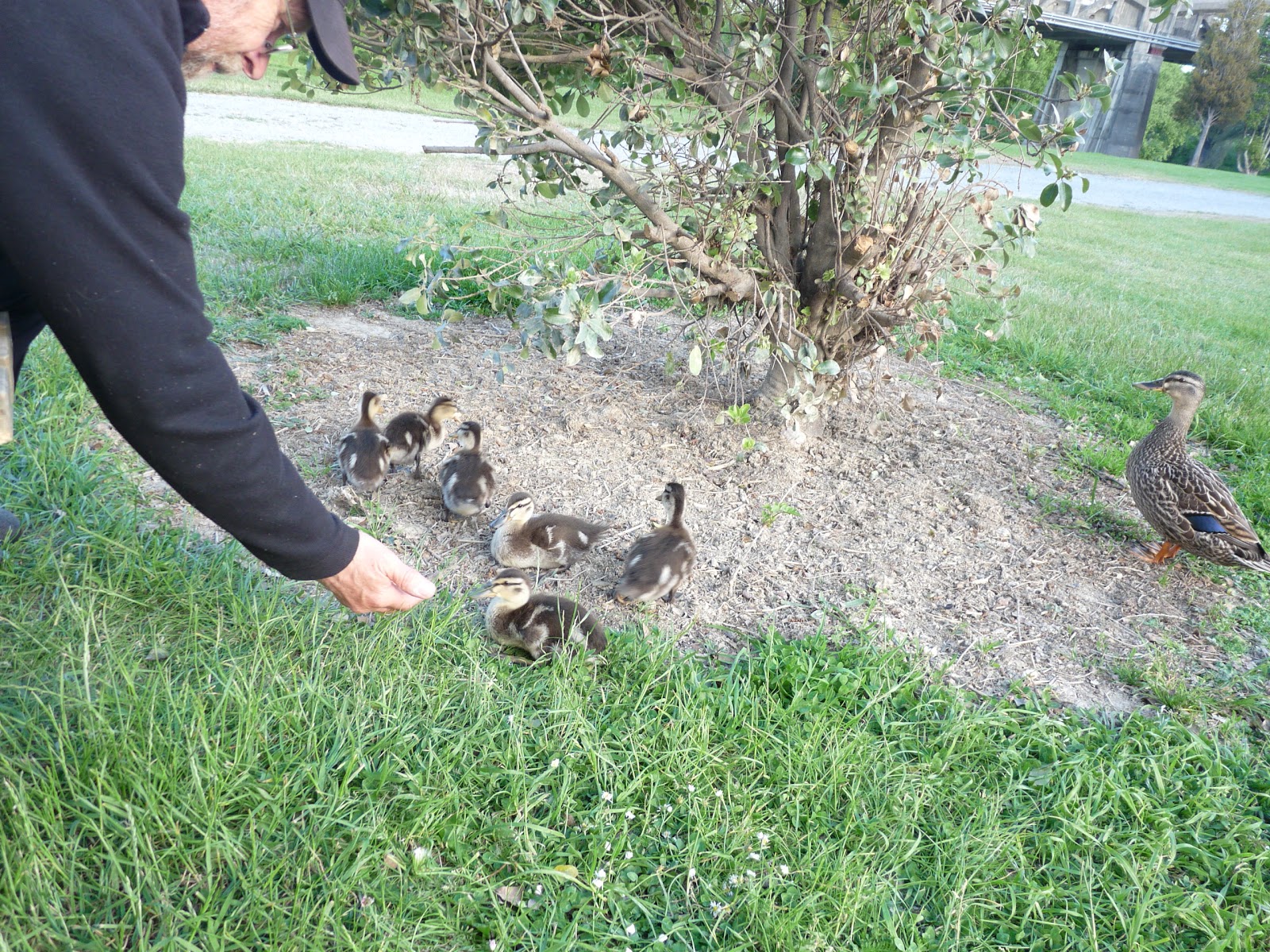
Feeding the ducklings, while the
mother duck looks on unconcerned.
Last night we cooked and had our tea outside rather than dragging everything over to the kitchen - the kitchen is up a little rise and then up some stairs (for some reason the facilities near us are in a building where everything is upstairs and nothing on ground level).  While we were eating, a mother duck and her six ducklings - we'd seen them down by the stream before - came over to see if there was anything going food-wise.  I went and got some bread, and while the mother looked on, her six ducklings scrabbled for bits of bread right out of my hand,  I've just passed them again coming back from the kitchen. They show absolutely no fear.

Later. We had a very quiet day all up, spending the morning mostly either reading, snoozing, or doing the puzzles we got from 1066.  I managed to complete three of these including one I hadn't been able to do the other day, but this afternoon I couldn't get my head round them at all.  Maybe I'd worn my brain out.  I finished the latest Ian Rankin tonight; very good read with a nice red herring running through the greater part of it.  I’m not sure that the solution to the serial murders is handled as much of a surprise: the killer is a character who doesn't turn until late in the book, and there's only Rebus's hunch to undo him.

This afternoon we drove into the town centre and wandered around doing our own thing separately: Celia at the op shops, me taking some photos and visiting the Millennium Gallery, which had a couple of exhibitions on (with paintings all for sale) but had no room for any of its permanent collection.  An ongoing problem apparently.

We were going to have potatoes for tea (along with some other things) but the potatoes had vanished out of the car.   Must have left them at my daughter's.  Tomorrow we're aiming to go to Picton and then round the coast road to Havelock and so to Nelson.  We're told that the coast road round the Queen Charlotte Sound is good and not too hilly.  Let's hope that's right!

Wednesday, October 31, 2007

An arty morning

For the first time since we’ve been in Europe, Celia went in one direction this morning and I went in another. We arranged to be home by three o’clock. I had the cellphone, and Celia had the number (and the street address). It felt quite strange, as we’ve hardly been apart for more than half an hour since we arrived in Hamburg at the beginning of the month.
Anyway, Celia went off to the mall/supermarket (I hardly need to remind you that these are her museums), and I went to the Museum of Fine Arts, which is in easy walking distance. And it was free.
What a dream of a place! In the large foyer, there are paintings that would barely fit on the walls of our apartment. As you go in beyond this there are rooms and rooms of wondrous religious art, some of it huge. Upstairs is a mixture of later art works, with more portraits, and then upstairs again are more modern works, though nothing seems to date much beyond the beginning of the twentieth century.
It was exhausting just trying to take it all in, what with Goya and El Greco and various other great Spanish painters on display. And then there were two courtyards: one is a wonderful fresh garden, with palm trees, and green, green plants. The other is bare apart from a statue of Martin de Tours and the beggar. However, around the windows on the first floor is a wondrous blue colour.
It’s interesting how limited the range of subject matter is in religious art. While the Spanish paint St Francis a good deal more than other countries, there are dozens of versions of the Crucifixion and the events surrounding it. Curiously there aren’t many Nativity scenes in this museum. But there is one vital and energetic picture of the Holy Family (plus John the Baptist). Unusually the two boys are grown men in this picture and along with Joseph they’re hammering away at something not very obvious in the centre in a very muscular fashion. Mary is stuck on one side.
St Sebastian comes in for several portraits. [That's him in the picture.] Here in Spain he’s always shown in his dying agony with just one arrow in him. (Usually in other countries there’s a welter of arrows). It’s a puzzle why he’s such a choice subject for artists. I’ve just had a look at the interesting Wikipedia article on him, and seemingly even though he was shot full of arrows he survived, was nursed back to health, and went on to bring more people to Christ. So it’s interesting that the Spanish versions have him with only one arrow, and obviously dead. The other curious thing is that he’s always virtually naked in whatever country he’s painted, and his body is always romanticised as being a fine specimen of young manhood. (The Spanish tend to make him a youth, in fact, which he wasn’t when he was shot.)
In the museum there are few examples of mythical art, though the Rape of the Sabines makes its usual appearance. It’s curious that this is another motif that’s so common in art of this time. Is it because we lean towards certain themes, or is it because of something altogether different? It’d be interesting to know.
After this I made my way into town (which is when I discovered that the Metro is both underground and tram) and finally found a place to post the postcards we’ve been carrying around for days. At the Post Office, of course. Post boxes are a rare thing in Valencia, as far as we can make out.
Celia finally arrived home half an hour after our arranged time, absolutely exhausted, of course, but still fairly cheerful. Her foot had stood up to the pace, apparently.

Tuesday, October 30, 2007

Celia puts a brave face on it


Today we managed two trips out, in spite of Celia’s sore foot. She bravely walked along at a snail’s pace, and eventually we got to where we were going.
First trip was to the covered Market, [see photo] which is reputed to the be the largest covered market in Europe. It may be, but it wasn’t somehow as pleasant as the market in Barcelona, which was only a couple of blocks away from our place of residence. The Valencia market is very spacious, and things are divided up more clearly, so that the fish market is isolated from the rest. Yet it didn’t have the friendly feel of the Barcelona one, nor the exuberance of the Melbourne one we saw three years ago. Never mind, we bought plenty of food there, enough to keep us going until we go home. It’s the first time we’ve actually had food on hand to any extent. We had a cup of coffee each in the café across the road - a real blue collar café - and the coffee was very black.
On the way back I found that there was an art exhibition in the building next door. I think the place is called Obras Sociales - or it could be Caja Mediterráneo. Both names appear on the two catalogues they gave me for free. Entry was free as well.
There were two exhibitions, one related to mental health in the community (related very loosely, but that’s by the by), and the other by Marlén Ramos, about whom I know nothing really since the text is all in Spanish. Both were good exhibitions: the first had paintings collected together from a variety of 20th century artists, many of whom are now dead. Ramos’ work came under the cover of ‘Patchwork Paintings’ and were carefully crafted abstract pieces. Both the catalogues have reproductions of all the paintings in their respective exhibitions. That was a bonus.
Our second trip out was to the Aquarium. We got the 95 bus as far as we thought it went and then found that it went all the way. Unfortunately this meant Celia had to walk some distance, from in front of the Science Museum, past the next building and the covered garden and right down and around the corner to the Aquarium entrance. In due course we got there!
Pluses. The walruses were a delight, swimming on their backs right under where we were watching from, and huffing and puffing and grunting and making rude noises in their usual fashion. The something-or-other whale (I’ll really have to take a notebook with me) was equally enthusiastic about swimming past us, as was a single penguin in a large area that had lots of other penguins preening themselves. The first area we went into had fish from coral reef areas; two huge tanks with hundreds of fish of all sorts swimming around. There were seats between the two tanks so you could just sit and relax. (After our walk it was essential.) The hypnotic tank of jellyfish, and of course, the seahorses and seadragons were a delight.
Minuses. In spite of this being touted as the biggest aquarium in the world, it isn’t the most exciting. It’s spread out over a large area, but includes three restaurants in that area. The walruses and that whale are in tanks that really aren’t big enough for them long-term, and having an aviary in an aquarium seems a bit odd. The flamingoes and pelicans have a lot of room, but there are only ducks in another pond (!) and what are they all doing in an aquarium? The tropical fish aren’t particularly colourful - in fact, there were far more colourful fish in the shop we went to in Norfolk (for free) than there were here.
I think the aquarium in Melbourne, though not so large in terms of space, is actually better value for money. Presumably the Valencia one has plenty of room to expand!
Worst Minus: the terrible music that accompanies you wherever you go in this place. It's monotonous and trivial.
And so back onto the 95 bus, which we thought would take us in a loop back around to the Towers of Serranos, which are at the top of our street. When we got to the bridge across the riverbed that leads onto the towers, Celia said she didn’t feel like walking across, so we stayed on the bus assuming that in ten minutes or so it would come back closer to home. Half an hour later we finally got there, having gone into the depths of suburban Valencia, and sat for five or ten minutes while the driver had a break. In the meantime it had got dark, which made seeing the Towers more difficult. And we were very hungry.

Wednesday, October 24, 2007

Sacreda Familia

Yesterday we got to Sacreda Familia (Holy Family) rather late, so didn’t go in. It’s Barcelona’s Cathedral, and is still being finished - after more than a hundred years! This isn’t for want of trying - there may have been some patches of inactivity since it was begun in the 1880s, such as during the Spanish Civil War (when the Cathedral was damaged) but in general it’s been on the go since day one.
It was the dream of a Barcelona bookseller, but I don’t suppose he ever dreamt he’d get what is now in existence. The first architect got as far as building the crypt area, which is substantial in itself, and now houses a museum to the second architect, Gaudi, who between other projects made it his life’s work to design the most remarkable cathedral in Christendom. He sometimes lived in the Cathedral; he had his workshop there at times, and he’s buried there. He’s so honoured that I’m sure most Barcelonians know his name. And he deserves all the honour heaped on him. Somehow he managed to create a monument to God, to Christ (and Mary) and to creation that is so strange and so remarkable that at first you just don’t know what to make of it.
Our first view of it, from across the street, made us wonder what the heck the place actually was. Because it’s still being built, there are cranes everywhere, and scaffolding. Several of the twenty odd towers that will eventually exist are there, and some of them have been there for more than a century. But your first impression of the building is of towers that are full of strange holes, and of a surface that’s so decorated you can’t grasp anything.
Fortunately, when you get up close you realise what’s going on. The way the surface seems to be sliding off itself, like icing melting on a cake, isn’t the case at all: the surface is covered with natural things such as plants and animals. Sculptured vines and creepers cover the building; there are dozens of sculptures of animals and people: stories from the Bible, and liturgical symbols. Each spire has a different top, and nothing is repeated anywhere. At present the tallest tower is 120 metres; in due course the one that focuses on Christ will be 170 metres, making the Cathedral not only the tallest building in Barcelona, but also the tallest church in the world.
Gaudi said: to be original go back to the Origin. And he has done. He continually studied plants and animals to see how things were structured, and used the designs in his buildings. (Not just the Cathedral but also all of his other architectural pursuits.) This created enormous problems for his sculptors, his engineers, his stonemasons, and everyone else connected with the building. But so loyal were they to Gaudi, and to his vision, that they overcome the problems again and again. Gaudi himself made intricate models of the most difficult parts of the structure, and many of these are on display in the museum in the crypt. Unfortunately most of his drawings and plans were destroyed in the Civil War, but subsequent architects and others have worked hard to discover exactly what he intended and to make sure his intentions are carried out.
The inside of the cathedral is at present full of scaffolding, but some areas are complete. In due course all the windows will have stained glass in them, but for now only two of these are finished, and they are both kaleidoscopes of colour. The inner columns weave up to the ceiling area like great plant stalks. None of them are simply round: they have been built so that they almost spiral upwards. In the ceiling itself, the stone is shaped like flowers and leaves, and these hang out over the columns. The balcony, which is high above the floor, and goes along both sides of the building, will hold 1200 to 1500 singers one day - when the place is complete. It’s shaped in a great wave, weaving in and out. The staircases are spiral, and you can already climb far up to the top of what’s completed - or take a lift. Celia reckoned Health and Safety would have something to say about thousands of tourists coming into a building site - which is what it is. Most of the floor is covered with moulds, and great pieces of stone, and building materials.
Outside what is currently the front entrance, are some of Gaudi’s famous leaning columns. These start out some distance from the wall, and fall back onto it, as it were. And over the doors are sculptures of the fourteen stations of the Cross. They’re not in the usual order - Christ naked on the cross is at the centre - but they wonderfully vivid, and striking.
As you can see, the place made quite an impression on us. And then we got a bus to Parc Guell, which was originally intended to be a place where sixty of Gaudi’s designed houses would be built. In the end only two (and a gatehouse) were finished. It’s now been turned into a park for the public, and has more of his almost outrageous designs scattered about. Perhaps more on those in the next post.

Tuesday, October 23, 2007

When in Rome - do the laundry!

Yesterday [now three days ago] was another laundrette day. Don’t know why we’d run out of clothes so quickly again, but it was very necessary. Maybe we’ve left some behind somewhere. Anyway, we also supermarketed, which gave Celia a bit of a rush. In the afternoon we headed into the old part of town again, specifically to the Colosseum. Got ourselves conned into having our pictures taken with a couple of ‘Roman guards’ who then demanded ten euros for the privilege. Celia gave them two euros and they said she was stingy. The Colosseum, like much of the area in the old Roman forum, is being restored. Some of it looks quite new, in fact. Many of the old columns in the forum have been put back together, jigsaw fashion, and there’s a huge amount of restoration going on. I don’t know that we walked through this area last time we were in Rome, but it’s certainly getting a lot of attention.
As we came out of the forum we discovered the Paul Gauguin exhibition that we’d read about. It was being held in the back of a building which we’d passed several times and hadn’t been able to name. Turns out it’s the main Art Gallery - at least as far as I understand.
The Gauguin, interestingly enough, didn’t have many of his South Sea Islands paintings, which are mostly what I’ve known him for. But it did have a wide range of his pictures overall, including a lot of his early work, which is wonderfully coloured, and a delight to the eye. To the end he remained a superb colourist, and seeing these early works as well has confirmed he’s an artist I really enjoy. His life, like so many of the artists of his time, was a muddle, and the political statements that the write-ups on him in the exhibition claim he was making are not that obvious - to my eye, anyway.
And talking of painting: we made our way to the Piazza del Popolo towards evening (after having had an excellent and economic meal at the Railway Station). Celia wanted to go there because it was close to the place we stayed at last time we were here. But neither of us could remember exactly where we had stayed, unfortunately. Anyway, the Piazza, when we got there, didn’t look at all familiar (!) and neither did the surrounding streets. But halfway along the Corso we came across this boy, who couldn’t have been more than 15 or 16, and he was painting with spray cans. He’d flip each can out of the box, give it a twist and a shake (rather like those guys in bars who throw cocktails around to mix them - and show off), and then set to with complete understanding of what he was doing to produce a painting. The whole thing was performance art, really, because it was done at great speed, with utter confidence, using the cans, the hands, pieces of cardboard torn on the spot, an old pie dish (for part of a circle), mixes of colour done with ease, and a total concentration that was a bit scary for someone of his age. At the end of it he sold the painting on the spot to someone for ten euros (!) He was working by the light of the shop next door, and at one point someone came out and said he needed to move along because the crowd watching him was blocking the shop doorway. So he just upped his equipment and moved a metre further, and then got back onto the job. There was another painter doing something similar further along the road - actually working almost in the dark - but he none of the panache of the boy.

Tuesday, October 16, 2007

Bit more update

Celia's over in the corner reading another Ian Rankin thriller - he's become our writer of the month while we've been on holiday, even though we had to leave behind one of his novels because of the weight (we'd finished it, of course) along with a Jane Austen (Northanger Abbey) that I brought with me.
Anyway, today we've been on two city bus tours, and seen a good deal of the place, including Fiesole, the kind of 'other' city that exists near Florence. (It's virtually a suburb these days.) Seemingly the two places have a long and entwined history of conquering and being conquered. I didn't realise Florence was the capital of Italy for a relatively brief period in the 19th century, either.
Fiesole is set up on the hill above Florence. The villas there are surrounded by cypress trees, many of them planted by the British when they fell in love with the place in the 19th century. Elizabeth Barrett Browning is buried in one of the city's inner cemetaries, along with other British worthies.
We haven't yet got into any of the galleries - some of them were closed today - but that's on our agenda for tomorrow. I thought we'd found Michaelangelo's David, yesterday, but it turned out to be a copy they have in one of the squares here (along with some dozen other famous statues). It's full-sized, and is still a remarkable piece, but in fact the real thing is inside a major gallery here in Florence. We'll track it down tomorrow.
Michaelangelo is Florence's famous son, of course, but he shares fame in the city with Dante, Goldini and a heap of other well-known names. Did someone mention Da Vinci? Think he's well connected with the place too, if I remember rightly, but my brain's gone a bit numb listening to an endless commentary while on the buses.
Part of our day today involved doing the laundry. Things like that shouldn't happen on holiday, but of course there was no way we could carry enough clothes with us not to have to do the laundry at all. Celia sat in the laundrette chatting to a couple of New Zealanders who were there at the same time.
I've bought what she calls a 'man bag' after my wallet loss. It slings around my shoulder and curiously enough it's a lot easier way to carry far more than I could ever carry in my pockets - and it's still relatively compact. Jokes about the ' man bag' have been rife, but I've got big enough shoulders...
Tonight we dined in the Chinese restaurant across from our hotel. Had four and five course meals between us, sharing a good deal. Ended up with fried ice cream. Yup. Ice cream inside a ball of batter. In-ter-est-ing.
Our hotel room has a balcony with shutters on the outside of the window, french windows inside that (made of aluminium), ordinary french windows inside that again, lace curtains, and shutters on the inside over the glass in the inner french windows. Hope you're thoroughly confused. The only doors that actually shut out of that lot are the outside shutters.
There's an antiquated lift that will only hold the two of us (getting inside it with our backpacks was a mission), but it works well. Needs to, as we're on the fifth floor. Our hotel reception is on the second floor (piano in Italian) and another hotel has the floors between. There's a third hotel on the same side of the building somewhere, plus the two or three in the other half.
Italy is certainly different. The bathroom basin doesn't drain for ages, there are bidets everywhere you look (in the bathrooms, I mean - we had one in our bedroom in Milan), all the wall plugs are funny shapes (Switzerland's were worse, with about six holes to a plug), our room overlooks a balcony below, and right into the windows opposite.
But Florence is a delight. After Milan, it's just lovely. And sunny! Eat your heart out, all you poor freezing Dunedinites!

Thursday, October 04, 2007

First day in Hamburg

....and exhausted. We came home about 4.30 and slept.
Most of the day we’d spent in doing the hop on hop off thing on one of the double-decker buses that tour around Hamburg city. They take about an hour and a half to do this, and we got off twice. The bus we’d started out on was the 100, but the one we went back onto was the 200, and it takes a somewhat different route - in fact we wound up going over much of the route we’d already taken but approaching it from the opposite direction. Finally, somewhat desperate that we were never going to get back to point A, we got off in Rathaus Square (Rathaus is just the Town Hall - I suppose the ‘rat’ part has some links with ratification), and walked back along Monckebergerstrasse to the Hauptbahnhof - the main railway station - which is just near the hotel.
Doesn’t sound like an exhausting day, you say?
Well, our first hop off was at St Michael’s Church, and instead of going into the church proper, as we’d thought, we found ourselves climbing up the tower. At least 25 flights of stairs, if not more. By the time we’d got to the point where we’d both have preferred to have given up, we thought we might as well carry on. Certainly the view from the tower was amazing, but it took a while to get the breath back. We got the lift back down (yup, this is a church with a lift to the tower), and none of the passengers had quite figured out, when we got to the bottom, how to get the door to open. So we all went up to the top of the tower again, before coming down.
After this we finally got into the church itself, and it’s an amazing building. Wonderful curves everywhere to offset the usual straight lines of the architecture. It’s been thoroughly restored, so all the golds and whites are as they would have been. It just glistens. And because it’s Harvest Festival (here as in England) the church was full of decorations related to food: wreaths made of vegetables and stalks hanging from the balcony; breads in all sorts of shapes (such as a mouse and a snake); an enormous canopy affair hanging in the sanctuary made out of corn sheaves, and various statements such as Our Father (in German, of course) made out of bread on a baked backing.
Hamburg is an extensive city, with a large port and waterfront. We went past areas with houses that are worth several million euros - wonderful places on the street that’s closest to the large lake that’s within the city. There are embassies everywhere, and of course these are all large and imposing - and no doubt costing their home country a large amount of money. The buildings vary in their materials, but there are many that are made out of bricks, vast structures rising way above the street. The whole place has a very permanent air about it, an air of having survived a cluttered history. It’s going full steam ahead at present: there are acres of building going on, both office space and apartments, down by the water.
It was a holiday today (not sure what holiday) and the crowds were out in full force, but most of the shops were shut. Restaurants were doing an enormous trade. We went into the railway station first thing this morning to get our Eurail pass sorted out. We were hoping that they actually knew what it was all about, and of course they did. We’ve booked ourselves a couple of seats to Cologne for tomorrow - booked seats because of the holiday today, which apparently might affect tomorrow‘s travellers.
The railway station is large, as you’d expect, full of shops. There’s one area that’s given over to food shops, all within a kind of mall. You just wander from one food group to another. And there are plenty of other shops - including the ubiquitous McDonald’s where we went and had a milkshake (again) tonight, and watched while a couple of teenagers spent almost all the time we were there in a long, long kiss. A long kiss.
There was also a kind of large mini-market (if that makes sense) and Celia was in her element. I’ve come to the conclusion that English or Continental supermarkets are a kind of art gallery or museum to her. When I proposed this new theory, she smiled enigmatically.

Sunday, September 09, 2007

Museum of History and Art

Friday was a big day, in terms of walking anyway. We were going to be meeting our host and hostess and their daughter for an evening meal and to catch up with a free jazz concert, but during the day we’d planned to go the Museum of History and Art, which we’d tried to get into on Monday, but it was closed.
This is an amazing building, quite apart from the exhibits. When you go in on the ground level, you think the building will just go upwards from there. In fact there are four lower levels going deep into the ground, and the new foundations are mixed with the old walls of much earlier buildings - and you can actually touch these wall, which date back to who knows when. (Someone will; I don’t.)
On level -2 or thereabouts is the recreation of an actual Roman mosaic floor - almost complete. And on the walls down there are the pieces that have been found of some murals from Roman times. Down in this area are items from thousands of years ago, long before Christ, little items that probably were of no great significance in their day but which take on great significance because of their age and the fact that they’ve survived.
As you work your way up the building you progressively come closer to your own times, although there’s a sudden lurch from the mediaeval period to the 19th century. And what’s there from the 19th century is mostly military material: guns, portraits of famous soldiers and battles.
And then another leap forward into the 20th century, which is where most of the art is. One painter, Joseph Kutter is very well-represented; he’s a Luxembourg painter who uses colours somewhat akin to Chagall but his subject matter and style is different. I liked his paintings, especially his portraits (including two or three autoportraits, as they’re known.
Of course there’s plenty of other art, but more in the area of sculpted works from the Romans and from churches - huge lumps of stone sometimes with carvings intact, sometimes not. Or metalwork and the like from all eras. It’s a great place, though its focus is a little diffuse…!

Joseph Kutter is considered one of Luxembourg's most important painters. He lived from 1894 to 1941 and was greatly influenced by the Impressionists.

Friday, August 10, 2007

Oxburgh

I didn’t get round to writing my post on Oxburgh yesterday, so here it is now. Oxburgh turned out to be one of the most delightful Halls we’ve visited. It was owned by the Roman Catholic Bedingfeld family until it was given to the National Trust in 1952. However, the Bedingfelds still live in some part of it.
There’s a wall all the way around, with towers at intervals, and a wide open garden area as you enter. A stream runs along one side; well, when I say stream, I’m not sure that it goes anywhere, but it’s like a stream, and there a beautiful lily-pads in flower over towards a little platform. Across it at one point is a bridge which has a pulley on it, so that part of it can be raised to allow a small boat through. Small, as in a rowboat.
In front of the Hall is the parterre garden. I guessed this meant something along the lines of ‘by earth’ but in fact the proper translation is on the ground, which seems just a little bit obvious for a garden. Wikipedia tells us that a “parterre is a formal garden construction on a level surface consisting of planting beds, edged in stone or tightly clipped hedging and gravel paths arranged to form a pleasing, usually symmetrical pattern. Parterres need not have any flowers at all. French parterres were elaborated out of 16th-century knot gardens.” The parterre at Oxburgh is elaborate and colourful - and it does have flowers, and a knot shape.
Beyond this is the Hall itself, surrounded by a moat, which may have only arrived in the 19th century as there was a photograph inside the building of men working on it. The building (which was begun in 1482) itself has been added to and altered but in spite of its inconsistencies of design is strong in its features. There’s a bridge over the moat and plenty of fish in the water. We couldn’t tell what kind they were, except that they were black, or dark in colour, and about 6-8 inches long. Long iridescent dragonflies hovered over the water.
Apparently the house was originally U-shaped, but the fourth side was filled in by the industrious Victorian, and there is now a courtyard in the centre. The Victorians also added the Flemish-style windows and the terracotta chimneys.
While the house is interesting to walk around in, its major claim to fame is that it has a priest’s hole. This was a hiding place for Catholic priests in the time when they were being hunted down. The hole is in an interesting place. One of the rooms above the main archway was slept in by King Henry VII. The privy (it has a more particular name which I’ve forgot) was up a short flight of steps. Behind this was the trap to flush out the doings; in the troubled times, this trap didn’t flush anything out but hid the priest who had a small ‘room’ beneath. His access was in fact through the trap, and he would have had to have been a fairly skinny fellow to get through it.
Above the King’s room was the Queen’s, reached by a stone spiral staircase. And further up the staircase again is access to the tower overlooking the roof. There’s more access to something above that again, but it was closed to us yesterday.
Unless you have a good idea of period furniture and style it’s hard to tell what was original in the house and what has been added. The Victorians seemed to have collected a great deal of carved wood, sometimes adding it to existing furniture. Only someone with particular knowledge would know what belonged to what.
Yesterday there was an art exhibition on at the house as well. Art in the sense of ‘someone’s idea of art.’ It consisted of copy after copy of various ‘common’ items such as books, hotties, tanks and airplanes (!) all made in white porcelain. The artist had a philosophical reason for making all this stuff - these sorts of artists always do - but in fact it wasn’t particularly exciting, and it detracted considerably from the genuine art and furniture and fittings in the house. Fortunately the stuff was only in two rooms, otherwise it would have been quite irritating. One of the volunteer guides expressed some considerable disdain for it, as well he might.

Tuesday, July 31, 2007

Felbrigg Hall

Today we went to Felbrigg Hall, and its walled garden. The latter is a delight, with pear and apricot trees and other such fixed to the inside walls, so that all the fruit hangs readily available. The herb garden runs almost the entire length of one side of the garden, and there is a dovecote at the very back. Flowers of every kind mingle together in an orderly fashion - flowers I’ve never come across in some cases. And the vegetable garden, which was large and varied, was so tidy that veges would have no choice but to grow well. In one of the glasshouses the smell of honeysuckle was overwhelming. Altogether a great find, and one of the many places we should try and get back to, since it’s only a couple of miles away from where we’re staying at present.

The house itself is rather undistinguished from the outside, in the sense that it’s very square at the front, and the older part doesn’t seem to quite meld with the newer section. Be that as it may, inside it’s well worth visiting, as all these places have been. Paintings galore - I mean paintings on almost every available surface. This is typical of all these houses: dozens of ancestors stare down at you, and in Felbrigg’s case they’re joined by a lot of landscapes, far more than I remember coming across elsewhere, and many naval battles. Then there are all the busts, and a marvellous collection of bronze statues of heroic gods and picaresque scenes, such as a stag being held by three or four people, or a thoroughly weary stag almost lying on top of his beaten rival.

I meant to mention that on the outside of Felbrigg’s entrance, high up on the third floor, are the words Gloria Deo in Excelsis (Glory to God in the highest) carved out in letters large enough to read easily from some distance.

The library is so full there’s a second room with books - perhaps a reading room - and then there’s a little alcove off that again, sunny and uncluttered, where someone could sit and read, or contemplate. There are a lot more modern books in this library than we’ve seen in other libraries too - modern in the sense that they may have actually been published in the 20th century. One of the Walpoles was obviously a favourite of some inhabitant of the house, as possibly all of his published works are there. (Having said that, I thought at first it was Hugh Walpole, who, incidentally, was born in NZ. However, it may have been Horace Walpole, who was an 18th century author.)

There’s also a headless lady from around 300 AD - she sits in a rather lonely fashion amongst all the stuffed birds in a kind of museum area. Not a very dignified place for such an elderly person, I would have thought.

One of the plastered ceilings consists of large ‘drops’ - I don’t know the technical name for them; they’re rather like huge upside-down chess pawns. Another one is ornate in an almost rococo style.

It’s very hard to convey any sense of these places. They’re so full of magnificent works and of wonderful design that you walk through them, mouth open, but not entirely taking it all in. A second and third visit might begin to help you become familiar with the place and its treasures. But there are so many houses around the country, and so much treasure in them, it’s unlikely we’ll get to see any of them more than once.

Wednesday, July 18, 2007

Ickworth House

We found our way to Ickworth House today. Turns out to be only about ten minutes from where we’re staying. It’s not as old as the other two National Trust homes we’ve been to, and it’s larger and more imposing than either of them. An enormous rotunda (see picture) is the centrepiece of the building, with east and west wings extending from it. The interior of the rotunda is about all that’s available to view; the west wing contains a large restaurant, foyer and the obligatory shop while the east wing has been formed into a hotel.
Ickworth must be one of the NT’s showpieces. Certainly a large amount of money has gone into keeping it up to scratch, aided by the fact that the family who owned it put plenty of solid money into it over various generations.
The house and gardens (some 1800 acres of them!) have been in the Hervey family since the mid-fifteenth century, but Ickworth House was only begun in 1795. It was the creation of a rather eccentric member of the Hervey family: Frederick, the 4th Earl of Bristol and also the Bishop of Derry, neither places being remotely near Ickworth, as far as I know. Frederick can’t have had a lot of time to be a Bishop, as he spent much of his life collecting things for his house – mostly abroad in Europe. Consequently, the house has a host of marvellous silverware, gold plate, various statues and busts, an intriguing collection of metal fish thingees - I can’t remember their purpose – around thirty miniatures, stuff from the Orient, and umpteen paintings, mostly portraits. Included amongst these are works by Gainsborough, Hogarth, Reynolds, Poussin, Velasquez and Titian. (I think there are actually only one each of the latter two artists, but the Titian is a superb portrait, the head shining out of a dark background.)
Besides all this, the design of the house is breathtaking. You walk into the Rotunda and there’s a large foyer, with a ceiling reaching up some thirty feet. When I say ceiling, I actually mean a glass roof, a curved glass roof. (One person there today was observantly asking: were the panes of glass actually curved, or just the shape of the roof as a whole?). Beyond this glass ceiling the building goes up further, and by stretching your neck you can see a metal spiral staircase clinging to the side of the upper storeys, and more storeys above that again. As Celia said, you wouldn’t want to drop anything while you were up there.
Everything in every room smacks of wealth, and beauty, and good taste. The walls are covered in portraits, many of them nearly life size. I think there are over 200 portraits around the place. But the furniture and fittings and adornments are all top of their class. (Only one pair of ornaments, candleholders in the form of a couple of very pink cherubs, seemed kitsch rather than classy.)
There are around 7,000 books in the various shelves and the library. Many of them were rebound at the beginning of the 19th century to make sure they stayed whole. Apparently most have been read at some point, as there are pencil notes scattered throughout. (Those people who will insist on annotating their own books!)
The house and gardens were given to the National in 1956 in lieu of death duties. The east wing was supposed to stay in the hands of the family, but the rather notorious 7th Marquess of Bristol sold it to the NT in 1998. He had managed to blow a £30 million pound fortune away in his short life – he died at 44, possibly from AIDs and definitely after having been involved in the drug scene. The next Marquess in line tried to buy the east wing back, but the NT refused. However, they did complete the unfinished west wing, in partnership with Sodexho Prestige.