After a couple of days recovering from the Luxembourg leg of our trip, as it were, we’ve now begun the next stage: tenting our way around England for about three weeks. The idea of tenting rather than going to places where we have a proper roof over our head has been debated for a few weeks; Celia wants to save money and certainly this approach will help. But I’m not the world’s most enthusiastic tent person. Especially when it means we have to set up every night in a new place and take down every morning.
Well, tonight’s the first night, and we managed to get into a caravan/holiday home place by a river in a village called Huntingford Abbots. (Yes, I know.) The village is full of old thatched roof houses, and some more modern ones that fit into the scheme of things, and it’s very quiet. It’s near the town of Huntingdon.
We came here via Newmarket, a place that was a bit of a disappointment. Probably not Newmarket’s fault at all, but having read so many Dick Francis books in which it appears, and listening at the moment on a cassette in the car to yet another of Francis’ Syd Halley stories, perhaps my expectations were too high. I didn’t think there was much atmosphere in Newmarket, and I only saw one jockey the whole time we were there. Perhaps we should have gone there to see the races, as I’d suggested a while ago.
We were going to check in at a camping site nearer to Newmarket, but we noticed in the book as we were heading there that we couldn’t park our car beside our tent. Which would have been painful when it came to hoisting all the gear out of the car and into the tent, or when we were cooking and so on. As it is we seem to have taken over the place.
Anyway, tomorrow night we have to be in London (New Malden, to be precise, which is more like Kent than London proper) and we’ll be sleeping in a real bed there. So we’ll hardly have got used to tenting than we’ll be back to ‘normality.
Showing posts with label luxembourg. Show all posts
Showing posts with label luxembourg. Show all posts
Tuesday, September 11, 2007

Sunday, September 09, 2007
Museum of History and Art
Friday was a big day, in terms of walking anyway. We were going to be meeting our host and hostess and their daughter for an evening meal and to catch up with a free jazz concert, but during the day we’d planned to go the Museum of History and Art, which we’d tried to get into on Monday, but it was closed.
This is an amazing building, quite apart from the exhibits. When you go in on the ground level, you think the building will just go upwards from there. In fact there are four lower levels going deep into the ground, and the new foundations are mixed with the old walls of much earlier buildings - and you can actually touch these wall, which date back to who knows when. (Someone will; I don’t.)
On level -2 or thereabouts is the recreation of an actual Roman mosaic floor - almost complete. And on the walls down there are the pieces that have been found of some murals from Roman times. Down in this area are items from thousands of years ago, long before Christ, little items that probably were of no great significance in their day but which take on great significance because of their age and the fact that they’ve survived.
As you work your way up the building you progressively come closer to your own times, although there’s a sudden lurch from the mediaeval period to the 19th century. And what’s there from the 19th century is mostly military material: guns, portraits of famous soldiers and battles.
And then another leap forward into the 20th century, which is where most of the art is. One painter, Joseph Kutter is very well-represented; he’s a Luxembourg painter who uses colours somewhat akin to Chagall but his subject matter and style is different. I liked his paintings, especially his portraits (including two or three autoportraits, as they’re known.
Of course there’s plenty of other art, but more in the area of sculpted works from the Romans and from churches - huge lumps of stone sometimes with carvings intact, sometimes not. Or metalwork and the like from all eras. It’s a great place, though its focus is a little diffuse…!
Joseph Kutter is considered one of Luxembourg's most important painters. He lived from 1894 to 1941 and was greatly influenced by the Impressionists.
This is an amazing building, quite apart from the exhibits. When you go in on the ground level, you think the building will just go upwards from there. In fact there are four lower levels going deep into the ground, and the new foundations are mixed with the old walls of much earlier buildings - and you can actually touch these wall, which date back to who knows when. (Someone will; I don’t.)
On level -2 or thereabouts is the recreation of an actual Roman mosaic floor - almost complete. And on the walls down there are the pieces that have been found of some murals from Roman times. Down in this area are items from thousands of years ago, long before Christ, little items that probably were of no great significance in their day but which take on great significance because of their age and the fact that they’ve survived.
As you work your way up the building you progressively come closer to your own times, although there’s a sudden lurch from the mediaeval period to the 19th century. And what’s there from the 19th century is mostly military material: guns, portraits of famous soldiers and battles.
And then another leap forward into the 20th century, which is where most of the art is. One painter, Joseph Kutter is very well-represented; he’s a Luxembourg painter who uses colours
 somewhat akin to Chagall but his subject matter and style is different. I liked his paintings, especially his portraits (including two or three autoportraits, as they’re known.
Of course there’s plenty of other art, but more in the area of sculpted works from the Romans and from churches - huge lumps of stone sometimes with carvings intact, sometimes not. Or metalwork and the like from all eras. It’s a great place, though its focus is a little diffuse…!
Joseph Kutter is considered one of Luxembourg's most important painters. He lived from 1894 to 1941 and was greatly influenced by the Impressionists.
Echternacht
 On Thursday our hostess drove us to Echternacht, a smallish town north-east of Luxembourg city. It’s famous for a couple of things, particularly, the Catholic Abbey and its surrounding university, and the Roman remains. The latter is particularly special: for instance out near the local lake are the foundations of an old Roman villa, still intact (with some restoration as well) and showing the extent of the building as well as the pool in the front of the house. This is almost as long as the main building. I presume it was decorative rather than for swimming purposes (!)
The Romans populated this area pretty thoroughly in the past, and, as I’ll mention in the next post, their ‘leftovers’ are everywhere.
In the town of Echternacht itself we went and visited the Abbey which is primarily known for its association with Willebrod, [sometimes Willebrord] a British bloke who decided that the people of the area needed evangelising - some 1300 years ago. He was so popular that people have been making pilgrimages along the routes he took in his evangelising ever since. The church he built in Echternacht at first, was soon too small, and one of the wealthy Christians of the area donated funds to build a much bigger one. (Willebrod was dead by this time.) This second church was destroyed by fire around the year 1000, if I remember rightly, and so a third (and bigger) church was built. The French Revolution damaged this one to a great extent, and with the ensuing secularisation of the area, the shell of the church was used as a place for tradesmen to work in.
In due course, Christianity (particularly Catholicism) came into its own again, and in the 19th century the church was restored to such an extent that it was virtually a new church. Unfortunately, this church was thoroughly bombed in the Second World War, and so a fifth reincarnation of Willebrod’s church came into existence. This is virtually a new building, with absolutely superb modern stained glass (wonderfully colourful) but little else in the way of decoration. The old crypts are still there and Willebrod’s tomb is in one part of them. A sketch of his effigy on one of the tombs (the one we saw has a kind of stone boxing over the top) shows the effigy not in the usual state of repose, hands folded across the chest and eyes closed, looking as though the work is done. Nope, Willebrod is on his back, but is up on his elbows, eyes open, looking for all the world as though he’s had a rest and ready to go again.
Echternacht is full of cafes and gift shops - in the area we were in - but has lots of charm. We stayed and had lunch - onion soup with soggy croutons in it for mine hostess and me, and some sort of sausage dish for Celia. She’s been very keen to try out the sausages, but hasn’t quite made it generally. There’s such a choice of sausages, it’s hard to know where to start. And of course, they don’t exactly fit into the Weight Watchers’ scheme of things.
Thursday, September 06, 2007
Luxembourg 2
More travelling around Luxembourg today. This time we walked down to the Place de la Constitution and caught one of the green buses that do a continual loop around the city - the hop on hop off fellers. Near the Philharmonie (a wonderful round building where concerts and such are presented) we got off and went into the Musée d’Arte Moderne Grand-Duc Jean. This has been built partly over old city walls and battlements - the originals are still there, but they’ve been built up again with modern stones and plaster. It’s a large glass and stone building, very light and airy, and with a very open feeling. And, after yesterday’s trials, it was great to find that not only did they have free lockers for our bags, but free toilets! (So we both went twice.)
The exhibitions are another story. At present there is a great deal on Science Fiction and Modern Life scattered around the place. Some of it is interesting, and some of it is very strange, and some of it is more philosophy than art. It was worth going to, but we might have felt more aesthetically satisfied if we’d made it to the Gallery that we keep missing out on seeing, which is in the older town.
The photo is of a house that was to have been the prototype of many similar places - until the 1973 oil crisis caused problems. The houses were to be made in plastic. Curiously enough, there’s a house constructed on exactly the same lines near Warrington, close to Dunedin. I think in fact that that house is bigger - and I don’t think it’s made of plastic.
After the Musée we got the bus again and went to the building which has a name that sounds like Ocean, but isn’t. It’s a large mall with an enormous supermarket on the first two floors (Celia was in her element in the supermarket: the choice!), and then up above are offices, in one of which our host actually works.
We had waited at the bus stop with a woman from Belgium. She’d been to Luxembourg a number of years ago and was astonished by the rapid rate of building along the area where the Musée and the Ocean are. The place has been taken over by Banks - Luxembourg has some 200, apparently - and not all of them are squeaky clean, according to what she was saying. There has been some scandal with Clearstream Banking and the French Government and others, for starters. But the EU also came in for some criticism: a man from one of the EU countries wanted to retire to Greece (I can’t remember at the moment where he came from). This should be perfectly acceptable under EU terms, but he’s been blocked from doing so. Not being the sort of person to take this lying down, he has made aggressive protest in the EU Justice System (which is in Luxembourg), talking in terms of dictatorship and other such pleasantries. He’s now been in Luxembourg for 250 days, fighting his case.
Luxembourgers are losing their own status in the face of thousands of workers who stream into the place daily from nearby countries, and through the many foreigners who live there permanently. I was asked by a German tourist how to get to the autobahn while I was waiting at the bus stop - of course I didn’t know, and neither did a young couple who came along, and neither did someone else. ‘Luxembourg is a city of strangers,’ I said to a woman standing by, and she agreed. No one really lives there, so no one knows anything about it.
The exhibitions are another story. At present there is a great deal on Science Fiction and Modern Life scattered around the place. Some of it is interesting, and some of it is very strange, and some of it is more philosophy than art. It was worth going to, but we might have felt more aesthetically satisfied if we’d made it to the Gallery that we keep missing out on seeing, which is in the older town.
The photo is of a house that was to have been the prototype of many similar places - until the 1973 oil crisis caused problems. The houses were to be made in plastic. Curiously enough,
 there’s a house constructed on exactly the same lines near Warrington, close to Dunedin. I think in fact that that house is bigger - and I don’t think it’s made of plastic.
After the Musée we got the bus again and went to the building which has a name that sounds like Ocean, but isn’t. It’s a large mall with an enormous supermarket on the first two floors (Celia was in her element in the supermarket: the choice!), and then up above are offices, in one of which our host actually works.
We had waited at the bus stop with a woman from Belgium. She’d been to Luxembourg a number of years ago and was astonished by the rapid rate of building along the area where the Musée and the Ocean are. The place has been taken over by Banks - Luxembourg has some 200, apparently - and not all of them are squeaky clean, according to what she was saying. There has been some scandal with Clearstream Banking and the French Government and others, for starters. But the EU also came in for some criticism: a man from one of the EU countries wanted to retire to Greece (I can’t remember at the moment where he came from). This should be perfectly acceptable under EU terms, but he’s been blocked from doing so. Not being the sort of person to take this lying down, he has made aggressive protest in the EU Justice System (which is in Luxembourg), talking in terms of dictatorship and other such pleasantries. He’s now been in Luxembourg for 250 days, fighting his case.
Luxembourgers are losing their own status in the face of thousands of workers who stream into the place daily from nearby countries, and through the many foreigners who live there permanently. I was asked by a German tourist how to get to the autobahn while I was waiting at the bus stop - of course I didn’t know, and neither did a young couple who came along, and neither did someone else. ‘Luxembourg is a city of strangers,’ I said to a woman standing by, and she agreed. No one really lives there, so no one knows anything about it.
Wednesday, September 05, 2007
Luxembourgish
 Just to clarify a note I made a couple of posts ago. Luxembourgish is an old language, dating back a thousand years or more. I’d thought that it hadn’t ever been written down properly until the last few years, but that’s a mistake. There were plenty of books in the language in the 19th century alone. But its spelling has been revised, and only as recently as 1976 when a new spelling system was adopted. You can read some Luxembourgish in the street names (Nie Wee has to New Way, surely), but you don’t see it written much around the city. In the suburb we’re staying in, Senningerberg (which is spelt differently on a sign just along the road!) the street names are all Luxembourgish. There are several streets with Gaass as part of the name. I assume it’s something like the English word, Close, though these Gaass aren’t cul-de-sacs. Unfortunately it doesn’t appear in the only Luxembourgeois (see what I mean?) dictionary I could find on the Net.
And something else about the language here: the children are taught in German in primary school, and in French in secondary school. (Not all subjects, but several.) So they don’t just learn these languages; they’re immersed in them. I gather that German got its foothold during the War, when the Germans occupied all sorts of European states. And then French took over after that.
There's a curiosity just along the road: Charly's Gare. A Gare, as I mentioned in the last post, is a railway station (although the airport is also called a Gare!). Charly's Gare is a former railway station that's now a restaurant. But where did the possessive apostrophe come from? The French don't use apostrophes in that way: for them it's always the railway station of the Charly. (I don't think Charly was a person, by the way; more likely the place.) So how come this looks like an English possessive apostrophe?
Getting to grips with Luxembourg
 Two of the Express trains meeting in the Pétrusse Gardens. The tail of the train we were on is at the right of the picture.
 This afternoon Celia and I went into Luxembourg city again, and caught the Pétrusse Express for a trip round the gardens and through various streets and byways. It’s a kind of train, in that it has an engine and engine driver, and three or so carriages. The travellers sit in little sections each for three people - though we managed to get a section to ourselves for some reason. The train doesn’t go on rails, however, but drives about on the road, a little like those children’s trains you see at festivals and such; in fact, it seemed debatable that this train would manage to carry its fairly large number of passengers up and down the steep roads. It did.
We’d booked online, but when we took the printed out email to the booth, the woman looked at it in some bewilderment. Seems as though online bookings are fairly rare, and that her boss wasn’t being very helpful at the other end of the phone. Nevertheless we got the tickets, and caught the train. There’s an ongoing commentary in various languages presented on earphones (you plug into the ceiling) and though it’s a little odd, because it dramatises some of the history (and one bloke even breaks into song) it gave us some background to the places we were passing. Though it wasn’t as clear as the commentary on the bus that we got on next. This hop on hop off bus (how is it that English is used for some things here?) goes round the main city and outskirts, and you can get on and off at various points along the way using the same ticket. We didn’t get off but decided to go the whole way and get an overview. Tomorrow we’ll hop on again and hop off a bit more readily. (We can still use the same ticket within a 24-hour period.)
When we got off the bus at the Gare (Railway Station for those who’ve forgotten their French) we went to look for a loo. Luxembourg is still one of the places where they make you pay for going to the toilet. We’d kind of got used to Celia having to fork out 50c while I went for free in the older shopping area, but she baulked at 1Euro 10c at the Gare. (And I would have had to pay 60c which didn’t grab me either.) Foolish pair. If you find a toilet in Luxembourg, go. We spent the next half hour trying to find another; went into McDonald’s and they didn’t have one; in Quik, and they required you to get a token from the counter - and presumably buy something; and even into some smaller malls. No joy.
Finally came across one up near the bridge leading back to the old town. Occupé. Well, that’s what the light said, but whoever was occupeying it was taking forever, literally. Desperate straits. Finally, gritting our teeth, we walked towards the Cathedral and the old town. And just when I was planning (in my head) to sneak behind a bush or building, we came across a portaloo in the Cathedral grounds. Don’t ask me why it was there, but obviously God had decided enough was enough.
Tuesday, September 04, 2007
Luxembourg
 A view of William III Square with the Cathedral in the background.
 Today was our first full day in Luxembourg. It started somewhat late, as we were both very tired, and slept in - Celia more than me, in fact. And it was raining quite heavily. However, in spite of the rain we donned the raincoats we’d bought in the market at Norwich, and walked to the bus stop. Found the right bus just coming along, and twenty minutes or so later we were in the centre of Luxembourg.
Much of our day was spent in getting orientated and finding our way around the main streets. It’s the end of some sort of retail period when all the old stock is got rid of, so, even though it was raining (and raining heavily at some points) the retailers all had stalls outside their shops and were selling off stuff. I wish I’d had my camera with me, because the site of all the streets filled with umbrellas and stalls was quite delightful to the eye.
We found all sorts of interesting things: the old fish market which has several narrow lanes and odd street levels, and interconnections between buildings and lanes, and spiral staircases and about a dozen restaurants all crammed on top of each other. We found the Cathedral later in the day, a splendid building with wonderful modern stained glass fabulously coloured, and a display (I think) on the original altar of various gold monstrances and thurifers. The altar area just shimmered with colour. I’ve written elsewhere about the exhibition that was on.
The modern art museum was closed today, so we’ll have to catch up with it another time. It’s apparently well worth a look.
The day improved as we went on and was quite sunny by the time we were worn out. We still bought a couple of fold-up umbrellas for future use - they were going out at 50% off. We also found a supermarket hidden away inside another building - Celia was pleased. After all, what is a shopping area without a supermarket (or a DIY store)?
In the market we came across a stall where they were warning of the dangers of the Internet to children, and the need to be vigilant. But as a crowd eye catcher, there were two Sony model dogs on display, electronic machines that would sit, and beg, and take a ‘bone’ in their mouths, and walk, and wag their tails, and flick their ears - and in general be remarkable. But they only understood English!
In the next day or so we’ll go on one of the sightseeing trips and see what the rest of the place looks like.
Luxembourg is a curious place: the basic language spoken by children at home is Luxembourgish, which, according to Stephen (whom we’re staying with) has only begun to be written down in the last three years! The children then learn German very early on in their school careers, and then French a bit later. English comes fourth on the list. But when you go to a shop you can find the staff speaking both French and German (and English). Librairies (bookshops) have a mix of French and German books - and a very few English ones, but there are still many familiar faces and names on the covers. The street signage is in both German and French - but not necessarily both at the same time, or seemingly in any consistent approach. For all that Luxembourg is a very organised place: the environment is very important, and recycling is a big thing. Yet, there are very few shops where you can buy secondhand stuff. (Though Kim, our host’s wife, is going to take us to a large one at some point.)
We hadn’t realised that with the European Union in force, borders are no longer places where you have to present passports and be inspected. You sail through. The border between Germany and Luxembourg is halfway across a bridge, as far as the road is concerned, but the passport inspection offices are all derelict and closed. My host works for the European Union as a statistician, and he says that things are becoming more uniform throughout the Union (something that he, as a statistician, would appreciate I suspect!). Countries still retain their own identity, but things have more similarity than they used to have. They’re even similar to England: the parking ticket machine at the airport was an exact model of the ones we’ve been using in Norwich.
Monday, September 03, 2007
Gadding about
I don’t think I’ve travelled so much in a car since I was with the Opera Quartet in New Zealand back in the 60s. Because everything you want to go to is somewhere else, as it were, and by somewhere else I mean not within walkable distance or hop in the car distance, we seem to spend a lot of time driving. Trips that in NZ would have been considered major are here just part of the day. Driving to Norwich regularly is a good twenty-five-minute trip, or driving to Birmingham yesterday was like driving from Dunedin to Timaru, except that we had to drive on three lane highways regularly at speeds of up to 120 kph. You kind of get used to it, but it isn’t my idea of fun. Fortunately we’ve bought lots of audio books at various op shops and have been listening to them to pass the time on the long hauls. I’ve even driven to Norwich and back twice by myself. Now for someone who wasn’t keen on driving in England at all when we came, that’s pretty good going.
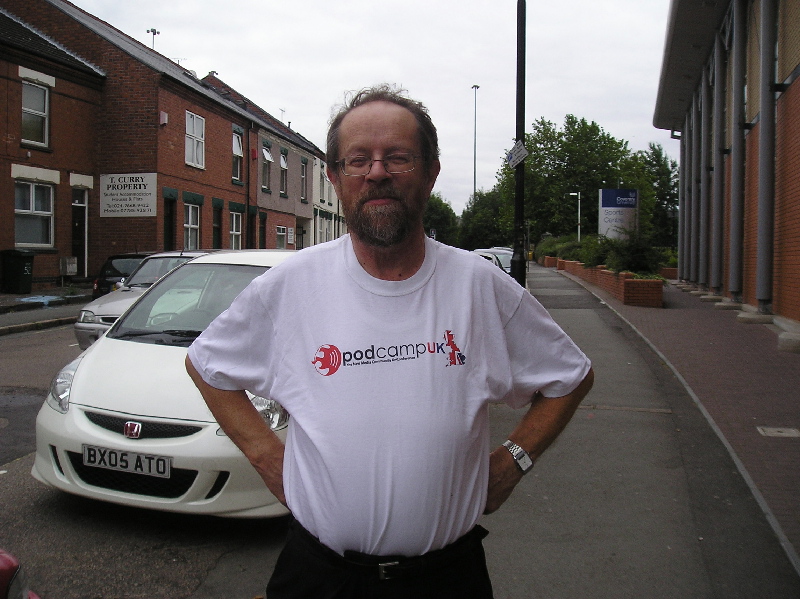
I spent much of yesterday (Saturday) at the PodCamp in Birmingham. I’ll be writing about it in due course on another blog or two, but suffice to say for the moment it was a stimulating and unusual experience. Celia went wandering in Birmingham itself, wore herself out, joined me at the PodCamp and listened in on a conversation between a dozen or more highly articulate podcasters, and then we drove home via Coventry Cathedral. (Which was terrific, but very focused on the sombre.) Then we had to sort out stuff for coming to Luxembourg, and this morning I was up just after six, because we had to leave fairly early to get to Stansted Airport for our flight. My brother-in-law drove us to the airport, we had to wait around for something like two and a half hours, often in queues, get onto a cramped plane, fly for an hour, meet up with Stephen C, whom I haven’t seen for around 35 years, and be driven by him from Frankfurt Hahn airport to his home in Luxembourg. And then of course it was catch-up time for Stephen and his wife, and Celia and me. Celia has retired exhausted to bed at an hour almost unheard of for her (8.30 English time, 9.30 Luxembourg time) and I’m sitting in a half-darkened room trying to get down some notes about what’s been happening.

I spent much of yesterday (Saturday) at the PodCamp in Birmingham. I’ll be writing about it in due course on another blog or two, but suffice to say for the moment it was a stimulating and unusual experience. Celia went wandering in Birmingham itself, wore herself out, joined me at the PodCamp and listened in on a conversation between a dozen or more highly articulate podcasters, and then we drove home via Coventry Cathedral. (Which was terrific, but very focused on the sombre.) Then we had to sort out stuff for coming to Luxembourg, and this morning I was up just after six, because we had to leave fairly early to get to Stansted Airport for our flight. My brother-in-law drove us to the airport, we had to wait around for something like two and a half hours, often in queues, get onto a cramped plane, fly for an hour, meet up with Stephen C, whom I haven’t seen for around 35 years, and be driven by him from Frankfurt Hahn airport to his home in Luxembourg. And then of course it was catch-up time for Stephen and his wife, and Celia and me. Celia has retired exhausted to bed at an hour almost unheard of for her (8.30 English time, 9.30 Luxembourg time) and I’m sitting in a half-darkened room trying to get down some notes about what’s been happening.
Subscribe to:
Posts (Atom)