One of my regular readers wants to know how we came to name our Sat Nav Malvina.
It was a brief but convoluted process. We’d been calling our borrowed Sat Nav, Margarita. Our Sat Nav comes from Garmin, but I think initially I read the company name as Garvin. We couldn’t give our SN the same name as the previous one, so we came to call her Malvina, because of the V in Garvin, and because Malvina is the name of one of NZ’s greatest opera singers. Still confused? You should be!
Saturday, July 21, 2007

Friday, July 20, 2007
My Sat Nav says...
I mentioned a while ago that we’d bought a Sat Nav (as they call them here) - in other words a GPS - for finding our way around the country. We called it Malvina.
Firstly, let me say she's been invaluable. We’d still be trying to find our way out of some back lanes without her. And she's user-friendly and mostly up to date. However, she also seems to have a mind of her own. When we asked her to take us from one large town to another, she would opt for the faster routes in terms of A roads, even though there were often shortcuts she could have used. When we started driving round some of the lanes nearby, on the other hand, she seemed to think that we’d like to go everywhere by back lanes, and we’ve had a frustrating couple of days trying to convince her that she needs to think about the best route, not the one that’s of the same kind as the last one we went on. Much and all as we enjoy country lanes, because there isn’t much traffic on them, they aren’t necessarily the fastest way to get to some places.
I've had to alter this post slightly, changing the pronouns, as I realised that I was calling Mavlina 'it' throughout. Oh, dear.
Thursday, July 19, 2007
Lavenham
Today’s been a less eventual day: we spent most of the morning enjoying the sunshine and each reading a Christopher Fowler mystery that we got in an op shop in Bury St Edmunds (I think – all the op shops are starting to coalesce into one homogenous mass).
But this afternoon we set off to Lavenham, primarily to see the Guildhall, which is 16th century, like the house we’re staying in, but also to see the various other 16th century houses in the main streets. Not so much because they’re 16th century but because they’re odd. Every one of them is skew-whiff. The ground floor sections aren’t too bad, but the upper storeys either lean to the left, or lean to the right, or even lean out over the street. Consequently casements are out of kilter, and presumably floors are likewise. In the Guildhall itself, in the upper storey, you go gradually downhill as you walk through the museum, and then back uphill again. Part of the problem no doubt, is age. Part of the problem surely must be that there’s been some upheaval in the earth beneath, or that the piles of the houses have shifted. Perhaps there was some manic builder who couldn’t set a house straight – my wife doesn’t seem to think this is a likely possibility. Whatever the situation, the strangest thing is that these houses have survived. You have to wonder why they haven’t been pulled down by some 19th century developer and replaced by something more sturdy – and secure!
By the way, Lavenham isn't pronounced like Taverham (in Norfolk) but like the beginning of the word, lavendar. The 'h' still goes missing, so we get Laven'am. Celia and I had a debate about the pronunciation, and of course she had to check it out with a local.
Wednesday, July 18, 2007
St Nicholas

 After we’d been to Ickworth yesterday, we took a bit of time wending along the back roads near where we’re staying. Came to Little Saxham and the church of St Nicholas, which has a round tower – a crenulated round tower in fact, for those who want to know such details. This means that it’s not just round, but has various indents and ‘windows’ in it.
It’s also been described as the most spectacular Norman round tower in Suffolk, by somebody called Pevsner. A man who ought to know, by the sound of it.
It’s a lovely little church, set amongst the quiet and peace of a graveyard (nothing like being reminded of where you’re heading when you go to church), and it’s in good condition, considering its age. It dates from the 12th century, though of course, as with all these buildings, there were various modifications over the centuries.
Inside, within the tower, is a small stained-glass window, made all the more effective by being set in walls that are a couple of feet thick, so that it shines out into the gloom.
The place was empty when we went inside, and we had to ourselves for the whole of our visit. I took a number of photos, though whether they’ll come out well is debatable; the flash wanted to keep flashing and made everything brighter than was helpful for detail. What I most wanted to try and photograph wasn’t the tower, which we couldn’t see well anyway (though I’ve included a photo from the Net here) but the wonderful carved animals on the ends of the pews. They were at both ends of each pew, and also at the place where you lean your arm, if you’re lucky enough to be sitting on the end of the row. Each one was different.
Unfortunately, a number of them have been worn away with time, and with children digging at them and various other mishaps, but the best remain. There are dogs, and lions, and sheep and various fierce exotic animals, all in height about the size of the full open stretch of a hand. They bring a delightful homeliness to the atmosphere of the place – even the exotic animals – rather like the pictures in a children’s book rounded out and made ‘real.’The Norman tower may be the architectural feature of the place, but I think we’re more likely to remember the animals a lot longer.
Ickworth House
 We found our way to Ickworth House today. Turns out to be only about ten minutes from where we’re staying. It’s not as old as the other two National Trust homes we’ve been to, and it’s larger and more imposing than either of them. An enormous rotunda (see picture) is the centrepiece of the building, with east and west wings extending from it. The interior of the rotunda is about all that’s available to view; the west wing contains a large restaurant, foyer and the obligatory shop while the east wing has been formed into a hotel.
Ickworth must be one of the NT’s showpieces. Certainly a large amount of money has gone into keeping it up to scratch, aided by the fact that the family who owned it put plenty of solid money into it over various generations.
The house and gardens (some 1800 acres of them!) have been in the Hervey family since the mid-fifteenth century, but Ickworth House was only begun in 1795. It was the creation of a rather eccentric member of the Hervey family: Frederick, the 4th Earl of Bristol and also the Bishop of Derry, neither places being remotely near Ickworth, as far as I know. Frederick can’t have had a lot of time to be a Bishop, as he spent much of his life collecting things for his house – mostly abroad in Europe. Consequently, the house has a host of marvellous silverware, gold plate, various statues and busts, an intriguing collection of metal fish thingees - I can’t remember their purpose – around thirty miniatures, stuff from the Orient, and umpteen paintings, mostly portraits. Included amongst these are works by Gainsborough, Hogarth, Reynolds, Poussin, Velasquez and Titian. (I think there are actually only one each of the latter two artists, but the Titian is a superb portrait, the head shining out of a dark background.)
Besides all this, the design of the house is breathtaking. You walk into the Rotunda and there’s a large foyer, with a ceiling reaching up some thirty feet. When I say ceiling, I actually mean a glass roof, a curved glass roof. (One person there today was observantly asking: were the panes of glass actually curved, or just the shape of the roof as a whole?). Beyond this glass ceiling the building goes up further, and by stretching your neck you can see a metal spiral staircase clinging to the side of the upper storeys, and more storeys above that again. As Celia said, you wouldn’t want to drop anything while you were up there.
Everything in every room smacks of wealth, and beauty, and good taste. The walls are covered in portraits, many of them nearly life size. I think there are over 200 portraits around the place. But the furniture and fittings and adornments are all top of their class. (Only one pair of ornaments, candleholders in the form of a couple of very pink cherubs, seemed kitsch rather than classy.)
There are around 7,000 books in the various shelves and the library. Many of them were rebound at the beginning of the 19th century to make sure they stayed whole. Apparently most have been read at some point, as there are pencil notes scattered throughout. (Those people who will insist on annotating their own books!)
The house and gardens were given to the National in 1956 in lieu of death duties. The east wing was supposed to stay in the hands of the family, but the rather notorious 7th Marquess of Bristol sold it to the NT in 1998. He had managed to blow a £30 million pound fortune away in his short life – he died at 44, possibly from AIDs and definitely after having been involved in the drug scene. The next Marquess in line tried to buy the east wing back, but the NT refused. However, they did complete the unfinished west wing, in partnership with Sodexho Prestige.
Small doors
I don’t like 16th century houses with short doors. I raced up the stairs this evening to answer the phone in one of the upstairs rooms, lowered my head to get through the doorway and still managed to nearly knock myself out on the lintel. Forgot about the phone and struggled to retain my wits as I lay on the floor gasping with the pain. I can’t believe that people in the 16th century were ever this small. To get through two of the doors upstairs you have to perform the kind of manoeuvre you’d use in one of those dances where people form an arch and you go under it. Most people look as though they’re never going to make it through one of those, so imagine how they’d get on here.
Tuesday, July 17, 2007
Bury St Edmunds

Spent most of today in Bury St Edmunds – once we’d woken up (at around 9.30 – very late even for us). Did the touristy thing, checking out the Abbey, and taking lots of photographs. The place is a constant reminder of its Christian heritage, with most of the streets in the centre having saints’ names or names associated with the church. There are other names, too, such as the usual market names, but the place is rife with Christian associations.
I didn’t know a thing about St Edmund until today. He was a king of East Anglia in the 9th century, and was slaughtered by the invading Danes (who camped at Thetford, incidentally). Whether he died on the battlefield or whether he was martyred by refusing to take up a sword against the invaders is not known for sure. The typical picture of Edmund is of him punctured with arrows, rather like Sebastian – there’s just such a picture in the Lady Chapel in the Abbey, with the angels pulling the ‘soul’ of Edmund out of his body and bringing him before God.
Bury is relatively hilly: not so much as my home town, but with enough hills to keep you fit. It has several op shops (charity shops), so we had plenty to keep us occupied. I found a pair of cufflinks in one of these shops and offered them £10 (they were marked at £11.99). They ‘weren’t allowed to change the prices,’ so I didn’t buy them. But in another op shop they were selling everything for a pound or less, and I got a more interesting and outlandish pair of cufflinks and a matching tiepin for a pound. Every town we’ve gone to has several op shops, often within spitting distance of each other. Literally, if you’re a good spitter.
The photo is of the Abbeygate, which stands alone at the moment, leading into the Abbey gardens, which are open to the public. I met an Black American woman in there yesterday with an albino ferret on a lead.
Monday, July 16, 2007
Introducing Potter
We went to see Harry Potter’s latest outing today. Classy movie, and succinct storytelling. More about it on my other blog.
But it was our first experience of moviegoing in the UK. The prices, as we expected, were pretty much on a par with prices at home. The expensive icecreams were pathetic: two scoops barely appeared above the rim of the cone. And the taste of the mint with chocolate bits in it was unpleasant, rather as if you were eating spearmint and chocolate together. No wonder some shops advertise New Zealand Ice Cream. From now on I'll make sure I buy from them.
But the worst feature was to come. At home we’ve come to endure the ten minutes or so of recycled tv advertising and trailers that come before the main feature. Ten minutes is copable with. 25 minutes is outrageous. Twenty-five minutes of advertising!
And because so many of the ads were played at full bore soundwise, we were nearly deaf by the time Harry and his cohorts arrived. Fortunately the film was worth watching after the interminable introductory stuff, almost fifty percent of which was advertising for cars. Do they have trouble selling cars in Britain? You wouldn’t think so by the number that are on the roads.
Saturday, July 14, 2007
Great Yarmouth
We went to Great Yarmouth today (Friday). It’s nothing like that other seaside town, Sheringham, which I found delightful.
However, for all its look of not having been given a good coat of paint for a while,
It didn’t help that our first main impression of
When we went down the stairs to get out of the building we found the stairs had picture after picture of nearly naked young ladies (they were being promoted for some contest in the Sun newspaper), and we wondered if we’d strayed into something iffy altogether! Obviously some sort of over 18 shows take place somewhere in the building – we didn’t wait around to discover where.
All this negative view of
Wednesday, July 11, 2007
Market

We discovered the Oxford market by accident: it’s similar in style to the inside market in Melbourne: lots of little permanent shops all crowded together under a permanent roof, some of them fully enclosed so you have to enter a door, some of them open (like the fish shop and the butchers) so you can buy straight over the counter, like you would in an open air market. One of the most appealing was a cake shop where they were doing the decoration of the cakes in full view of the public. They had dozens of things on display, cakes with people on them, and all sorts. And then there were hundreds of
 decorations you could buy to put on cakes, some of them edible and some not.
There was also a small café where they had free internet access, so of course we stopped there for a little while, as we carry the big baby, as it gets called to distinguish it from the little baby (the GPS), around with us most of the time for just such occasions. We only do this while we’re staying in places where we don’t have some internet access at home - we’ve been fortunate to be able to use other people’s broadband a lot of the time.
Oxford
 We’ve been to Oxford today [Monday], in spite of having to struggle our way through yet another traffic jam. The town is everything you’d ever heard about and much more. It’s full of delightful buildings from a number of eras, and decoration abounds. Once you’re in the centre you can’t help but stumble over history at every point. We sat for some time in a church - the University Church of St Mary Virgin, if I remember rightly - where John and Charles Wesley preached, and where John Henry Newman rattled the rafters.
We went to a free exhibition of books related to Plutarch and Dante and Boccaccio. Some of the books had belonged to Plutarch himself, and had his notes very tidily written in the margins. (Making comments in the margins is nothing new, obviously.) Some of the books had the most glorious paintings alongside the text (and more comments from the owners). The colour was as fresh as the day it was done. There were all sorts of editions of Dante’s work, and a number of pictures and cartoons and drawings connected to that great tryptich. (I once had an edition of Dorothy Sayer’s translation of the book, which I think I must have left behind last time I was in England. Unfortunately, along with a trunkful of other books that we left in the care of a family member, it’s never been seen again.)
Oxford is curiously busy in certain streets - chock full of mostly young people speaking other languages - and then suddenly quiet in another street. Bicycles abound (their riders inconsistent in their use of helmets) and students are everywhere, debating on the street, striding along listening to ipods, walking seriously from one famous building to another, or laughing and having the time of the lives in a place they can barely comprehend the history of. Who can? Trying to be aware of the fact of the famous people who’ve trod these streets is nearly impossible; even in the church I could only think that the people listening to Wesley and Newman were no different from me: they ate, drank and slept as I do. They were privileged to hear men I’ve never heard, but I wonder if they considered it a privilege at the time.
 In these church buildings you keep walking over memorial stones set in the floor. I’m not sure how many people are normally buried beneath these stones, or whether anyone is at all, but the memorials are a distinct reminder of our own mortality. One day, in a sense, people will walk over our graves too, careless as to who we are and what we did or didn’t do, incapable of appreciating our tiny role in the history of the world. It’s awfully sobering. Thank God we matter to God and to those close to us, otherwise it would be very depressing.
Traffic Jams
As I write this I’m sitting in a deckchair on the side of the A34. We were stuck in a very long queue of cars and trucks and decided to stop for a while to let the traffic clear. Of course, as soon as we pulled over (and I’d found some bush to go to the loo behind) the traffic got moving, and has been moving ever since. Never mind, the rest won’t do us any harm; it’s very tiring driving at 7 mph for half an hour on end.
We had the same problem this morning, driving to Oxford. The roads were chocker - on our side of the road. People going the other direction were away laughing. Now the people going in the opposite direction - again - are zipping along, and our lot of traffic has just come to a standstill once more. Frustrating way to drive, but I guess you get used to it.
When I came to England for the first time, some forty years ago, my uncle took me and his wife and daughter out on a Sunday afternoon drive. It was lovely on the way to wherever we went, but the return journey consisted of one long traffic jam that crawled along in the same way we’ve just been crawling along. I thought, if this is what a Sunday afternoon drive consists of, I’ll forego the pleasure from now on.
Forty years on and things haven’t changed, except now queues are a permanent feature of travel here. When we came down to Northampton from Norwich last week, we got caught in a long queue - there’d been an accident on one of the roundabouts - and were stuck in it while thunder thundered overhead and lightning flashed.
It’s been fine when we’ve gone on the quieter roads, of course, but our GPS likes to take us on the main roads, having the mistaken idea that they are the quicker roads. She’s refuses to take traffic jams into consideration.
Monday, July 09, 2007
What we did on Saturday - a very long post
First we went to see Celia’s older sister, and tried to get Skype working there. However, our earphones have been playing up, so we didn’t quite get off the ground. Did some chatting with a couple of other relatives, though.
We’d been intending to go to Stowe Gardens, but with Silverstone Grand Prix on, traffic is a little dense around some areas close by. So we had one of those days when you just stop where you feel like it and breath the fresh air. It’s been the best day we’ve had since we’ve been in England, in terms of sunshine. Not a drop of rain.
Our first diversion was Blisworth, which is just up the road from Roade. It turned out to be a lovely village and it had a canal running through it. In fact, Blisworth used to be a centre for storage in the 19th century, and a huge warehouse still stands by the side of the canal. We walked along the canal for some distance until we met a friendly dog on one of the canal boats. She turned out to be only 12 weeks old, and is an otter hound, a fairly rare dog these days. Her (lady) owner came out to see who she was talking to and we got chatting about living on a canal boat. And then her husband came along (he’d been making a cellphone call further along the path) and we found out that red diesel is what they use on the boats, but that soon, because of the European Union, they’re going to have to use black diesel. However, the French will still be allowed to use the cheaper red diesel!
We found out it costs £10 a night to moor in some parts of the canals, but in other places you can moor for a fortnight for free. To register your boat costs £500 a year, and that’s going up. The boat owners we were talking to have installed solar panels for some assistance with their electricity, but they also have a log burner on board, and in the winter (`even when it’s snowing’) they have to have the windows open because it’s so hot.
Finally Celia asked the ultimate question: could we have a look on board? The woman apologised for the mess the dog had made but in fact the interior was relatively tidy. Just inside the open deck area was the lounge, with a sofa and tv - the boat has all mod cons - and then there was the kitchen, then the bedroom with a double bed alongside one wall, and then the bathroom area with toilet, shower, bath - everything. And then further along still was the engine room and so on. It all seems so compact.
The husband had taken early retirement because he was so stressed working as a lorry driver. Now they just wander and stop where they like. It’s the sort of lifestyle that has an appeal, yet I don’t know that it would be for us, for more than a short period.
After this we walked to the next bridge, where there was a water run-off, and then back along the road to the car. Decided to go to Leitchborough as our next stop, and have lunch. Sat on the seat at the side of the road and watched three bikies go past, come back driving in the opposite direction, and then come back for a third time. Thought I should offer them our GPS.
Earlier in the week we’d thought about going to Canons Ashby (which for some reason I’ve been called Canons Albery for the last few days), as it’s a National Trust house. At first we were concerned about the Silverstone traffic, but there was none at that stage of the day.
CA was a bit disappointing, probably because we immediately compared it to Blickling. But CA is a NT house in decline, and there’s still a lot of restoration to do, and some that can’t be done. It’s very much tied into the history of the Dryden family (John Dryden, the writer, was a cousin of one owner), and the church across the road, where the Augustinian Canons once had not only a church building twice the size of what remains, but cloisters, farms and various other buildings, has the Dryden family names all over it. The buildings are nearly all gone, except for the smallish church with a seemingly much larger outside (rather like an inverse Dr Who tardis). It’s one of only four private churches in the UK. The Drydens are buried inside and outside, their banners are on the walls, and their lozenges, which are a kind of coat of arms on a diamond shape.
The house became more interesting as you moved through it. It’s been badly altered on a number of occasions: doors have been shifted, windows closed up and covered with a tapestry (and a door-sized shape cut into another tapestry); a fireplace that has plaster work on it is all skew-whiff because of the weight of the ceiling above it (the ceiling has been kept in place by the NT with a steel girder); two staircases go up side by side at one point, and in one room the original floor has been lowered by at least a foot. This, I think, was only discovered by the NT recently, and they’ve removed some of the later wall to expose the original house that’s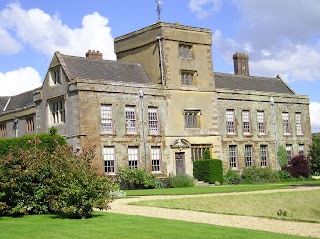 underneath, with old paintings done directly on the wall now visible as well as the place where the original floor sat. In the gallery there are a number of portraits and watercolours; most of them are hard to see because there’s so little light from the tiny Elizabethan windows. The doors opposite the windows are at all angles, because the house doesn’t sit straight - but behind these doors, apparently, are offices and bedrooms belonging to the owners of the house, who come home every so often.
It’s a strange place, but homely, somehow. The gardens are lovely, with a massive tree that has pinecones sitting on top of the flattish branches in groups of twenty or more, and various shrubs that have been trimmed into unusual shapes.
After we’d done the house, gardens and church, we headed back and stopped off in Greens Norton, another pleasant village. We went for a walk, which turned into a bit of a marathon, because we were following a path that led to something called the Pocket Park. One woman we met claimed it was lovely, so we persevered. After what seemed like half an hour of walking, we came across an area that used to be clay pits. It’s now been allowed to go back to nature, and this is the famed Pocket Park. A lake has been formed - it’s not very large, rather more of a oversized pond - and it’s covered in perfectly normal water scum. That’s fine for the wildlife, but not overexciting to look at. However, we were too tired to walk all the way back straight away so we sat and watched some strange little flying creatures that might have been dragonflies, but didn’t really have the look of them. Went into the pub on the way back and had a drink.
Finally we stopped in Towcester, where Celia’s two sisters both used to live and work. It’s an ancient town - I think it’s Roman name was Ludonium - and Watling St (the famous Roman road) goes through the middle of it, and acts as its High St. It’s an all right sort of place, but doesn’t seem to have much charm. We had fish and chips for tea, and a rather soggy Cornish Pasty. The English don’t seem to know how to make their own speciality: fish and chips. (Celia said the people in the shop weren’t English, but Chinese.) The fish was fine, but the chips lacked something - which the English usually disguise, I suspect, with vinegar.
We’d been intending to go to Stowe Gardens, but with Silverstone Grand Prix on, traffic is a little dense around some areas close by. So we had one of those days when you just stop where you feel like it and breath the fresh air. It’s been the best day we’ve had since we’ve been in England, in terms of sunshine. Not a drop of rain.
Our first diversion was Blisworth, which is just up the road from Roade. It turned out to be a lovely village and it had a canal running through it. In fact, Blisworth used to be a centre for storage in the 19th century, and a huge warehouse still stands by the side of the canal. We walked along the canal for some distance until we met a friendly dog on one of the canal boats. She turned out to be only 12 weeks old, and is an otter hound, a fairly rare dog these days. Her (lady) owner came out to see who she was talking to and we got chatting about living on a canal boat. And then her husband came along (he’d been making a cellphone call further along the path) and we found out that red diesel is what they use on the boats, but that soon, because of the European Union, they’re going to have to use black diesel. However, the French will still be allowed to use the cheaper red diesel!
We found out it costs £10 a night to moor in some parts of the canals, but in other places you can moor for a fortnight for free. To register your boat costs £500 a year, and that’s going up. The boat owners we were talking to have installed solar panels for some assistance with their electricity, but they also have a log burner on board, and in the winter (`even when it’s snowing’) they have to have the windows open because it’s so hot.
Finally Celia asked the ultimate question: could we have a look on board? The woman apologised for the mess the dog had made but in fact the interior was relatively tidy. Just inside the open deck area was the lounge, with a sofa and tv - the boat has all mod cons - and then there was the kitchen, then the bedroom with a double bed alongside one wall, and then the bathroom area with toilet, shower, bath - everything. And then further along still was the engine room and so on. It all seems so compact.
The husband had taken early retirement because he was so stressed working as a lorry driver. Now they just wander and stop where they like. It’s the sort of lifestyle that has an appeal, yet I don’t know that it would be for us, for more than a short period.
After this we walked to the next bridge, where there was a water run-off, and then back along the road to the car. Decided to go to Leitchborough as our next stop, and have lunch. Sat on the seat at the side of the road and watched three bikies go past, come back driving in the opposite direction, and then come back for a third time. Thought I should offer them our GPS.
Earlier in the week we’d thought about going to Canons Ashby (which for some reason I’ve been called Canons Albery for the last few days), as it’s a National Trust house. At first we were concerned about the Silverstone traffic, but there was none at that stage of the day.
CA was a bit disappointing, probably because we immediately compared it to Blickling. But CA is a NT house in decline, and there’s still a lot of restoration to do, and some that can’t be done. It’s very much tied into the history of the Dryden family (John Dryden, the writer, was a cousin
 of one owner), and the church across the road, where the Augustinian Canons once had not only a church building twice the size of what remains, but cloisters, farms and various other buildings, has the Dryden family names all over it. The buildings are nearly all gone, except for the smallish church with a seemingly much larger outside (rather like an inverse Dr Who tardis). It’s one of only four private churches in the UK. The Drydens are buried inside and outside, their banners are on the walls, and their lozenges, which are a kind of coat of arms on a diamond shape.
The house became more interesting as you moved through it. It’s been badly altered on a number of occasions: doors have been shifted, windows closed up and covered with a tapestry (and a door-sized shape cut into another tapestry); a fireplace that has plaster work on it is all skew-whiff because of the weight of the ceiling above it (the ceiling has been kept in place by the NT with a steel girder); two staircases go up side by side at one point, and in one room the original floor has been lowered by at least a foot. This, I think, was only discovered by the NT recently, and they’ve removed some of the later wall to expose the original house that’s
 underneath, with old paintings done directly on the wall now visible as well as the place where the original floor sat. In the gallery there are a number of portraits and watercolours; most of them are hard to see because there’s so little light from the tiny Elizabethan windows. The doors opposite the windows are at all angles, because the house doesn’t sit straight - but behind these doors, apparently, are offices and bedrooms belonging to the owners of the house, who come home every so often.
It’s a strange place, but homely, somehow. The gardens are lovely, with a massive tree that has pinecones sitting on top of the flattish branches in groups of twenty or more, and various shrubs that have been trimmed into unusual shapes.
After we’d done the house, gardens and church, we headed back and stopped off in Greens Norton, another pleasant village. We went for a walk, which turned into a bit of a marathon, because we were following a path that led to something called the Pocket Park. One woman we met claimed it was lovely, so we persevered. After what seemed like half an hour of walking, we came across an area that used to be clay pits. It’s now been allowed to go back to nature, and this is the famed Pocket Park. A lake has been formed - it’s not very large, rather more of a oversized pond - and it’s covered in perfectly normal water scum. That’s fine for the wildlife, but not overexciting to look at. However, we were too tired to walk all the way back straight away so we sat and watched some strange little flying creatures that might have been dragonflies, but didn’t really have the look of them. Went into the pub on the way back and had a drink.
Finally we stopped in Towcester, where Celia’s two sisters both used to live and work. It’s an ancient town - I think it’s Roman name was Ludonium - and Watling St (the famous Roman road) goes through the middle of it, and acts as its High St. It’s an all right sort of place, but doesn’t seem to have much charm. We had fish and chips for tea, and a rather soggy Cornish Pasty. The English don’t seem to know how to make their own speciality: fish and chips. (Celia said the people in the shop weren’t English, but Chinese.) The fish was fine, but the chips lacked something - which the English usually disguise, I suspect, with vinegar.
Some things that make England different to NZ
Baths appear to be deeper and narrower. Getting in or out of a bath requires a high stepping manoeuvre; you have to watch you don’t catch your foot on the edge and go for a burton.
I’d forgotten that a lot more people use gas for cooking - and grills above the cooker for making toast.
Op shops are called Charity Shops and they abound. And the stuff in them is very clean, very tidy, always in good condition. We’ve visited nearly every one we’ve seen, I think, and accumulated more books than we can hope to bring back with us.
The Eftpos (debit card) system doesn’t seem to be as well integrated as it is in NZ. There you can go anywhere with your Eftpos card and it will work. You can’t always guarantee it will here. Sainsburý’s supermarket particularly doesn’t like ours.
You can park your car either way on the side of the road. In other words, you don’t have to park facing the same way as the traffic. So cars are parked higgledy-piggledy all along the road.
People don’t have to wear helmets when they’re riding bicycles; but they can’t smoke inside. That law came in on the 1st July, with much hoo-hah, and one MP has already been caught on a train smoking with the cigarette out the window. He tried to claim he was smoking outside.
People still say, I shan’t, as part of their normal conversation.
Saturday, July 07, 2007
Interneting in the Rain
Yesterday we tramped around in drizzling rain trying to find one of the pubs in Northampton that has internet access available via The Cloud. The first place we went to was under new management, and the staff knew nothing about Internet access. One of the blokes at the counter suggested another public house a street away: this turned out to be only BT (British Telecom) wireless access, which wasn’t any good to us. We only discovered this after we’d bought a coffee and tea. (Strong, strong coffees and teas.)
Finally we made our way to Abington St and found two Cloud access places opposite each other. If it hadn’t been raining so hard we could probably have sat out in the street between them (it’s a no vehicular traffic area) and picked up the signal. In the end we chose Lloyds No 1 over the Wedgewood, because the music was too loud at the latter.
Lloyds No 1 is part of a chain of pubs around the country, and provided us not only with great tea and hot chocolate (covered in cream, the latter was) but with inexpensive meals. We got through some business on the Net and some blogging, but no Skyping. However we were back in town this morning because we wanted to look at the Market in Northampton (where some woman was selling very good DVDs, but changing the price to suit the customer!) so we skyped two of the kids and had a conference call with them.
Friday, July 06, 2007
Broads, Cripps, Roys
 Don’t think I’ve mentioned that we went to Wroxham - by accident. We were intending to go to Riverside in Norwich, and put in Riverside Shopping Centre on our GPS only to discover that Malvina (as we’ve named her - after a famous NZ opera singer) thought we meant the RSC in Wroxham. That was okay, as Wroxham is on ‘The Broads’ as the many waterways around Norfolk are called, and Celia wanted to go back and check them out. She’d sailed on them as a schoolgirl. They are lovely: houses built right down to the water’s edge, and boats galore. We debated hiring a boat for a week and exploring them, but that’s still up in the air at this stage, as it’s quite costly.
Anyway, the other interesting thing about Wroxham is that in the distant past a small corner shop named Roy’s once existed. Roy must have made a great deal of money as his name is now on a dozen shops, all within spitting distance of each other. The Riverside Shopping Centre is part of it, and there’s a DIY, a garden centre, a food hall, and you name it. All of them have “Roy’s” plastered over them. Obviously Roy was pretty canny with his money - and his buying up of properties. Anyway it gives Wroxham a very prosperous feel.
Roade has had a similar thing. Sir Humphrey Cripps began his working life as a very much underpaid factory worker. Over the course of his career he was able to buy out the Pianoforte Supplies business, which was at the time a very large company in Roade, and later took to making metal car parts when the piano scene quietened down. He owned an island in the Caribbean; he bought up Waterford Crystal in Ireland, and he owned companies in Canada and elsewhere. All in all he was a very wealthy man, He was also a very generous man. He built an entire secondary school; funded umpteen things at universities, old churches and the like (including doing a good deal of restoration work at the Roade Anglican Church: St Mary Virgin). There’s an old people’s home with his name on it up the road from where we’re staying, and no doubt there are dozens of other things that he paid for. The great blessing of a truly wealthy man is that he can give most of his wealth away.
The photo was taken at Horning, along the road from Wroxham - we forgot to get our camera out in the latter town.
Thursday, July 05, 2007
More Roade
The previous post was actually written yesterday, in case it seems confusing!
Second wander round the town this morning shows Roade to rather more varied in housing style than I’d first thought. There are slate roofs as well as the ubiquitous tiles; and there are thatched roofs. These aren’t just your any-old-day thatched roofs: they have patterns at the pitch of the roof like a pattern on a lace doily. Over the thatch, my observant wife pointed out, they stretch wire netting; it’s almost invisible. This seems to be more over the thinner thatching. There was at least one house that had very thick thatching, about a foot in thickness.
Everywhere you go in England, it seems, there are plastic windows frames. I’ve mentioned this before, and the keys that lock them all up. At least here, where we’re in a two-storey house, we can open the upper windows without fear that someone will climb up the spouting and burglarise the place. It’s a relief to have windows open at night, as it’s so muggy. But the door locks are intriguing: in order to lock the door you have to first force the handle right up (initially you think you’re going to snap it off). That causes a thin bolt to slide across, and then you can lock the door with the key. It took me a number of goes to figure out this handle twisting manoeuvre, and I’ve finally conquered it. Opening the door doesn’t require any manipulation of the handle, just a straightforward unlocking.
Roade
 We arrived in Roade today, after a much lengthier trip than we expected due to spending almost half an hour moving at a snail's pace in an enormous queue of traffic. The cause of the delay was an accident on one of the turn-offs - the one we wanted to go on, naturally. And while we were crawling along yet another one of the current series of thunderstorms struck, pelting hailstones down on the cars, and sending lightning streaking across the sky overhead. We didn't much enjoy driving on the A roads (they're a step down from the M roads). Even though the traffic isn't going full bore, there are usually three lanes of it, with dozens of immense trucks roaring along beside you.
I'm not sure why anyone would call a place Roade; it's a bit like calling a village Streete, or Footpath. Be that as it may, Roade is pleasant little town (it's rather more than a village, as it has at least two pubs), and I went for a walking survey of it this afternoon. After my comments about bricks everywhere in Norfolk yesterday, it was interesting to see that here in Roade they use bricks still, but much softer in colour; they're rather more sandy than red, though often red ones are mixed in with the lighter colours to produce a mottled effect. And they use flat stones (I'm not sure if it's slate) in the same way the people in Sheringham use beach stones. The town is a real mix of modern housing and old ones restored. But interestingly enough, while in Attleborough (where we've been for the last week) there's a real uniformity of design (to my eye, anyway) with lots of fairly square two-storey homes, often joined to at least one other, here in Roade, the more modern houses have a variety to them. There's the same basic brick structure, but there are interesting things done within the mold.
The Anglican church is well cared for, and has a modern hall built onto the back end. Obviously people still go to church in Roade. (Norfolk is packed with churches, with a mixture of square Norman towers and round Saxon towers. Many of them are in a bad way - having survived nearly a thousand years.) There's a street called Tithe Lane that leads down to the church - a nice reminder of one's duties! - and the usual bunch of Roads that have identical names with Closes. We're in Hyde Close, and originally went to Hyde Road (next door) where we knocked on the door of the house we thought belonged to our rellies, only to get some poor woman out of bed.
As I was walking around, I kept hearing what I thought were trains. I was right, as I discovered in due course. Running through the middle of Roade is a four-track railway system, and electric trains go speeding past with great frequency. I stood on an old stone bridge and watched them zipping their way beneath me.
I don't know how easy it's going to be for me to keep up my blogs for the next week or two: I'm having to use the laptop without any access to wireless or broadband. Still, one of the pubs is supposed to have wireless available, so I may have to sit there and type away, and drink the local ale!
Tuesday, July 03, 2007
The advantages of relatives
 We’ve either been staying with relatives or baby-sitting their houses since we got here, and that’s the way it’s going to continue till the end of August. As you’d expect that’s been great in terms of saving on accommodation. After August, of course, we might have to start paying our way!
But it has other advantages too. We have time to spend with people we only see rarely (some of them have been to NZ to visit us, some, particularly the younger generation, haven’t), and time to sit down and get to know each other better. Time even to spend helping with things like shifting a pile of roof tiles from the front of the garden – where the lorry dropped them off – to the back, beside the garage they’ll go on top of on Friday.
Roofs here are almost invariably tiled; some older houses are thatched, but obviously that’s not such a long term solution to roofing, though there are still thatchers around. And unlike NZ there are almost no houses with walls made of wood, or roughcast. Bricks are king here, and bricks are what houses are made out of. Bricks and more bricks. And more bricks. Bricks as far as the eye can see. The bricks in
Even the houses in Sheringham, which have walls mostly made of the beach stones (the older houses, that is), have brick corners for support. It gives a very distinctive flavour to the urban landscape.
Another curious thing is that where we’re staying at the moment, in Attleborough, many houses don’t have a street address. They’re known instead by names: The Elms, The Grove, The White House, Casa Novo, and so on. It must be a nightmare for a new postie!
Monday, July 02, 2007
Limited Choice
Billy Elliott: the musical (recycled film)
Blood Brothers – been around forever
Cabaret – been around forever (and been filmed)
Chicago
Dirty Dancing: the classic story on stage – (recycled film)
Fiddler on the Roof – been around forever and been filmed)
Kismet – been around forever and forever – and been filmed
Les Miserables – been around forever
The Lion King – (recycled film)
Lord of the Rings – (recycled film) (And can you imagine this saga being reduced to an evening's musical entertainment?)
Mamma Mia! – recycled music
Mary Poppins (recycled film)
The Phantom of the Opera – been around forever and been filmed
The Sound of Music – been around forever and ever and been filmed and shown forever
Out of these shows only The Lion King, Mary Poppins and Mamma Mia! get enough stars to warrant making the effort to go.
That leaves just two shows that are original pieces: The Drowsy Chaperone, and Spamalot. The DC is about a modern-day theatre buff whose favourite 1928 musical comes to life. Though this is a Tony award-winning show, and stars Elaine Page, it doesn’t get many stars. Spamalot, it turns out is another recycled piece: it’s Monty Python and the Holy Grail turned into a musical. However, it does get the fingers up as worth going to.
When I was in
Subscribe to:
Posts (Atom)