After making rude comments about Roade earlier in this blog, we’ve since come across a small village (barely more than a street, it seemed) called Bridge Street. It was somewhere between Bury St Edmunds and Sudbury.
And there are several streets called The Street. I’d always thought the High St was one of the most popular names for a street, but I don’t think I’ve seen a High St since I was here.
And then there’s the very curiously named Unthank Rd in Norwich. Unthank? Turns out that this isn't named after some ungrateful person, but after a particular family. You can get some more information from this article on the History Page.
Showing posts with label roade. Show all posts
Showing posts with label roade. Show all posts
Thursday, July 26, 2007

Saturday, July 21, 2007
HitTail on here
On my other blog I’ve often talked about the search results from a site called HitTail.com. It’s now doing the same thing for this Travel Blog, so occasionally I’ll be keeping an eye out to check what it’s finding.
Of course the obvious thing it’s going to find is my own name. I’ve mentioned on other blogs that it’s odd the way your own name turns up in different places, belonging to other people. I just found out that there’s a lawyer named Michael Crowl. He works in the Goldman Sachs group, in Hong Kong, and sounds like a bit of a high flying fellow. Hi, Mike!
Humphrey Cripps is a person I’ve talked about on this blog in relation to the little village of Roade, in Northamptonshire. He was a philanthropist, and the village, and the town of Northampton both benefited greatly from his giving. God loves a cheerful giver!
Someone searched for Coronation Hall Mosgiel photos, and dug up an old post of mine that is on the blog, and dates from 2001. Ah, the longevity of the Internet.
The final search was for Procrastination Opportunist, which is the name of one of the blogs listed at the side, and is written by the longtime friend of one of my sons. I clicked on it, to see if he’s still procrastinating, and blow me down, he’s been in China, with his brother, his mother, a friend of the family, and another couple we know well…in fact, I used to have lunch frequently with the husband of the pair up until recently. What people will get up to when you’re not at home to keep an eye on them!
Monday, July 09, 2007
What we did on Saturday - a very long post
First we went to see Celia’s older sister, and tried to get Skype working there. However, our earphones have been playing up, so we didn’t quite get off the ground. Did some chatting with a couple of other relatives, though.
We’d been intending to go to Stowe Gardens, but with Silverstone Grand Prix on, traffic is a little dense around some areas close by. So we had one of those days when you just stop where you feel like it and breath the fresh air. It’s been the best day we’ve had since we’ve been in England, in terms of sunshine. Not a drop of rain.
Our first diversion was Blisworth, which is just up the road from Roade. It turned out to be a lovely village and it had a canal running through it. In fact, Blisworth used to be a centre for storage in the 19th century, and a huge warehouse still stands by the side of the canal. We walked along the canal for some distance until we met a friendly dog on one of the canal boats. She turned out to be only 12 weeks old, and is an otter hound, a fairly rare dog these days. Her (lady) owner came out to see who she was talking to and we got chatting about living on a canal boat. And then her husband came along (he’d been making a cellphone call further along the path) and we found out that red diesel is what they use on the boats, but that soon, because of the European Union, they’re going to have to use black diesel. However, the French will still be allowed to use the cheaper red diesel!
We found out it costs £10 a night to moor in some parts of the canals, but in other places you can moor for a fortnight for free. To register your boat costs £500 a year, and that’s going up. The boat owners we were talking to have installed solar panels for some assistance with their electricity, but they also have a log burner on board, and in the winter (`even when it’s snowing’) they have to have the windows open because it’s so hot.
Finally Celia asked the ultimate question: could we have a look on board? The woman apologised for the mess the dog had made but in fact the interior was relatively tidy. Just inside the open deck area was the lounge, with a sofa and tv - the boat has all mod cons - and then there was the kitchen, then the bedroom with a double bed alongside one wall, and then the bathroom area with toilet, shower, bath - everything. And then further along still was the engine room and so on. It all seems so compact.
The husband had taken early retirement because he was so stressed working as a lorry driver. Now they just wander and stop where they like. It’s the sort of lifestyle that has an appeal, yet I don’t know that it would be for us, for more than a short period.
After this we walked to the next bridge, where there was a water run-off, and then back along the road to the car. Decided to go to Leitchborough as our next stop, and have lunch. Sat on the seat at the side of the road and watched three bikies go past, come back driving in the opposite direction, and then come back for a third time. Thought I should offer them our GPS.
Earlier in the week we’d thought about going to Canons Ashby (which for some reason I’ve been called Canons Albery for the last few days), as it’s a National Trust house. At first we were concerned about the Silverstone traffic, but there was none at that stage of the day.
CA was a bit disappointing, probably because we immediately compared it to Blickling. But CA is a NT house in decline, and there’s still a lot of restoration to do, and some that can’t be done. It’s very much tied into the history of the Dryden family (John Dryden, the writer, was a cousin of one owner), and the church across the road, where the Augustinian Canons once had not only a church building twice the size of what remains, but cloisters, farms and various other buildings, has the Dryden family names all over it. The buildings are nearly all gone, except for the smallish church with a seemingly much larger outside (rather like an inverse Dr Who tardis). It’s one of only four private churches in the UK. The Drydens are buried inside and outside, their banners are on the walls, and their lozenges, which are a kind of coat of arms on a diamond shape.
The house became more interesting as you moved through it. It’s been badly altered on a number of occasions: doors have been shifted, windows closed up and covered with a tapestry (and a door-sized shape cut into another tapestry); a fireplace that has plaster work on it is all skew-whiff because of the weight of the ceiling above it (the ceiling has been kept in place by the NT with a steel girder); two staircases go up side by side at one point, and in one room the original floor has been lowered by at least a foot. This, I think, was only discovered by the NT recently, and they’ve removed some of the later wall to expose the original house that’s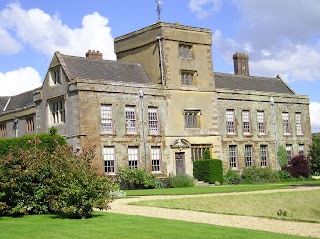 underneath, with old paintings done directly on the wall now visible as well as the place where the original floor sat. In the gallery there are a number of portraits and watercolours; most of them are hard to see because there’s so little light from the tiny Elizabethan windows. The doors opposite the windows are at all angles, because the house doesn’t sit straight - but behind these doors, apparently, are offices and bedrooms belonging to the owners of the house, who come home every so often.
It’s a strange place, but homely, somehow. The gardens are lovely, with a massive tree that has pinecones sitting on top of the flattish branches in groups of twenty or more, and various shrubs that have been trimmed into unusual shapes.
After we’d done the house, gardens and church, we headed back and stopped off in Greens Norton, another pleasant village. We went for a walk, which turned into a bit of a marathon, because we were following a path that led to something called the Pocket Park. One woman we met claimed it was lovely, so we persevered. After what seemed like half an hour of walking, we came across an area that used to be clay pits. It’s now been allowed to go back to nature, and this is the famed Pocket Park. A lake has been formed - it’s not very large, rather more of a oversized pond - and it’s covered in perfectly normal water scum. That’s fine for the wildlife, but not overexciting to look at. However, we were too tired to walk all the way back straight away so we sat and watched some strange little flying creatures that might have been dragonflies, but didn’t really have the look of them. Went into the pub on the way back and had a drink.
Finally we stopped in Towcester, where Celia’s two sisters both used to live and work. It’s an ancient town - I think it’s Roman name was Ludonium - and Watling St (the famous Roman road) goes through the middle of it, and acts as its High St. It’s an all right sort of place, but doesn’t seem to have much charm. We had fish and chips for tea, and a rather soggy Cornish Pasty. The English don’t seem to know how to make their own speciality: fish and chips. (Celia said the people in the shop weren’t English, but Chinese.) The fish was fine, but the chips lacked something - which the English usually disguise, I suspect, with vinegar.
We’d been intending to go to Stowe Gardens, but with Silverstone Grand Prix on, traffic is a little dense around some areas close by. So we had one of those days when you just stop where you feel like it and breath the fresh air. It’s been the best day we’ve had since we’ve been in England, in terms of sunshine. Not a drop of rain.
Our first diversion was Blisworth, which is just up the road from Roade. It turned out to be a lovely village and it had a canal running through it. In fact, Blisworth used to be a centre for storage in the 19th century, and a huge warehouse still stands by the side of the canal. We walked along the canal for some distance until we met a friendly dog on one of the canal boats. She turned out to be only 12 weeks old, and is an otter hound, a fairly rare dog these days. Her (lady) owner came out to see who she was talking to and we got chatting about living on a canal boat. And then her husband came along (he’d been making a cellphone call further along the path) and we found out that red diesel is what they use on the boats, but that soon, because of the European Union, they’re going to have to use black diesel. However, the French will still be allowed to use the cheaper red diesel!
We found out it costs £10 a night to moor in some parts of the canals, but in other places you can moor for a fortnight for free. To register your boat costs £500 a year, and that’s going up. The boat owners we were talking to have installed solar panels for some assistance with their electricity, but they also have a log burner on board, and in the winter (`even when it’s snowing’) they have to have the windows open because it’s so hot.
Finally Celia asked the ultimate question: could we have a look on board? The woman apologised for the mess the dog had made but in fact the interior was relatively tidy. Just inside the open deck area was the lounge, with a sofa and tv - the boat has all mod cons - and then there was the kitchen, then the bedroom with a double bed alongside one wall, and then the bathroom area with toilet, shower, bath - everything. And then further along still was the engine room and so on. It all seems so compact.
The husband had taken early retirement because he was so stressed working as a lorry driver. Now they just wander and stop where they like. It’s the sort of lifestyle that has an appeal, yet I don’t know that it would be for us, for more than a short period.
After this we walked to the next bridge, where there was a water run-off, and then back along the road to the car. Decided to go to Leitchborough as our next stop, and have lunch. Sat on the seat at the side of the road and watched three bikies go past, come back driving in the opposite direction, and then come back for a third time. Thought I should offer them our GPS.
Earlier in the week we’d thought about going to Canons Ashby (which for some reason I’ve been called Canons Albery for the last few days), as it’s a National Trust house. At first we were concerned about the Silverstone traffic, but there was none at that stage of the day.
CA was a bit disappointing, probably because we immediately compared it to Blickling. But CA is a NT house in decline, and there’s still a lot of restoration to do, and some that can’t be done. It’s very much tied into the history of the Dryden family (John Dryden, the writer, was a cousin
 of one owner), and the church across the road, where the Augustinian Canons once had not only a church building twice the size of what remains, but cloisters, farms and various other buildings, has the Dryden family names all over it. The buildings are nearly all gone, except for the smallish church with a seemingly much larger outside (rather like an inverse Dr Who tardis). It’s one of only four private churches in the UK. The Drydens are buried inside and outside, their banners are on the walls, and their lozenges, which are a kind of coat of arms on a diamond shape.
The house became more interesting as you moved through it. It’s been badly altered on a number of occasions: doors have been shifted, windows closed up and covered with a tapestry (and a door-sized shape cut into another tapestry); a fireplace that has plaster work on it is all skew-whiff because of the weight of the ceiling above it (the ceiling has been kept in place by the NT with a steel girder); two staircases go up side by side at one point, and in one room the original floor has been lowered by at least a foot. This, I think, was only discovered by the NT recently, and they’ve removed some of the later wall to expose the original house that’s
 underneath, with old paintings done directly on the wall now visible as well as the place where the original floor sat. In the gallery there are a number of portraits and watercolours; most of them are hard to see because there’s so little light from the tiny Elizabethan windows. The doors opposite the windows are at all angles, because the house doesn’t sit straight - but behind these doors, apparently, are offices and bedrooms belonging to the owners of the house, who come home every so often.
It’s a strange place, but homely, somehow. The gardens are lovely, with a massive tree that has pinecones sitting on top of the flattish branches in groups of twenty or more, and various shrubs that have been trimmed into unusual shapes.
After we’d done the house, gardens and church, we headed back and stopped off in Greens Norton, another pleasant village. We went for a walk, which turned into a bit of a marathon, because we were following a path that led to something called the Pocket Park. One woman we met claimed it was lovely, so we persevered. After what seemed like half an hour of walking, we came across an area that used to be clay pits. It’s now been allowed to go back to nature, and this is the famed Pocket Park. A lake has been formed - it’s not very large, rather more of a oversized pond - and it’s covered in perfectly normal water scum. That’s fine for the wildlife, but not overexciting to look at. However, we were too tired to walk all the way back straight away so we sat and watched some strange little flying creatures that might have been dragonflies, but didn’t really have the look of them. Went into the pub on the way back and had a drink.
Finally we stopped in Towcester, where Celia’s two sisters both used to live and work. It’s an ancient town - I think it’s Roman name was Ludonium - and Watling St (the famous Roman road) goes through the middle of it, and acts as its High St. It’s an all right sort of place, but doesn’t seem to have much charm. We had fish and chips for tea, and a rather soggy Cornish Pasty. The English don’t seem to know how to make their own speciality: fish and chips. (Celia said the people in the shop weren’t English, but Chinese.) The fish was fine, but the chips lacked something - which the English usually disguise, I suspect, with vinegar.
Friday, July 06, 2007
Broads, Cripps, Roys
 Don’t think I’ve mentioned that we went to Wroxham - by accident. We were intending to go to Riverside in Norwich, and put in Riverside Shopping Centre on our GPS only to discover that Malvina (as we’ve named her - after a famous NZ opera singer) thought we meant the RSC in Wroxham. That was okay, as Wroxham is on ‘The Broads’ as the many waterways around Norfolk are called, and Celia wanted to go back and check them out. She’d sailed on them as a schoolgirl. They are lovely: houses built right down to the water’s edge, and boats galore. We debated hiring a boat for a week and exploring them, but that’s still up in the air at this stage, as it’s quite costly.
Anyway, the other interesting thing about Wroxham is that in the distant past a small corner shop named Roy’s once existed. Roy must have made a great deal of money as his name is now on a dozen shops, all within spitting distance of each other. The Riverside Shopping Centre is part of it, and there’s a DIY, a garden centre, a food hall, and you name it. All of them have “Roy’s” plastered over them. Obviously Roy was pretty canny with his money - and his buying up of properties. Anyway it gives Wroxham a very prosperous feel.
Roade has had a similar thing. Sir Humphrey Cripps began his working life as a very much underpaid factory worker. Over the course of his career he was able to buy out the Pianoforte Supplies business, which was at the time a very large company in Roade, and later took to making metal car parts when the piano scene quietened down. He owned an island in the Caribbean; he bought up Waterford Crystal in Ireland, and he owned companies in Canada and elsewhere. All in all he was a very wealthy man, He was also a very generous man. He built an entire secondary school; funded umpteen things at universities, old churches and the like (including doing a good deal of restoration work at the Roade Anglican Church: St Mary Virgin). There’s an old people’s home with his name on it up the road from where we’re staying, and no doubt there are dozens of other things that he paid for. The great blessing of a truly wealthy man is that he can give most of his wealth away.
The photo was taken at Horning, along the road from Wroxham - we forgot to get our camera out in the latter town.
Thursday, July 05, 2007
More Roade
The previous post was actually written yesterday, in case it seems confusing!
Second wander round the town this morning shows Roade to rather more varied in housing style than I’d first thought. There are slate roofs as well as the ubiquitous tiles; and there are thatched roofs. These aren’t just your any-old-day thatched roofs: they have patterns at the pitch of the roof like a pattern on a lace doily. Over the thatch, my observant wife pointed out, they stretch wire netting; it’s almost invisible. This seems to be more over the thinner thatching. There was at least one house that had very thick thatching, about a foot in thickness.
Everywhere you go in England, it seems, there are plastic windows frames. I’ve mentioned this before, and the keys that lock them all up. At least here, where we’re in a two-storey house, we can open the upper windows without fear that someone will climb up the spouting and burglarise the place. It’s a relief to have windows open at night, as it’s so muggy. But the door locks are intriguing: in order to lock the door you have to first force the handle right up (initially you think you’re going to snap it off). That causes a thin bolt to slide across, and then you can lock the door with the key. It took me a number of goes to figure out this handle twisting manoeuvre, and I’ve finally conquered it. Opening the door doesn’t require any manipulation of the handle, just a straightforward unlocking.
Roade
 We arrived in Roade today, after a much lengthier trip than we expected due to spending almost half an hour moving at a snail's pace in an enormous queue of traffic. The cause of the delay was an accident on one of the turn-offs - the one we wanted to go on, naturally. And while we were crawling along yet another one of the current series of thunderstorms struck, pelting hailstones down on the cars, and sending lightning streaking across the sky overhead. We didn't much enjoy driving on the A roads (they're a step down from the M roads). Even though the traffic isn't going full bore, there are usually three lanes of it, with dozens of immense trucks roaring along beside you.
I'm not sure why anyone would call a place Roade; it's a bit like calling a village Streete, or Footpath. Be that as it may, Roade is pleasant little town (it's rather more than a village, as it has at least two pubs), and I went for a walking survey of it this afternoon. After my comments about bricks everywhere in Norfolk yesterday, it was interesting to see that here in Roade they use bricks still, but much softer in colour; they're rather more sandy than red, though often red ones are mixed in with the lighter colours to produce a mottled effect. And they use flat stones (I'm not sure if it's slate) in the same way the people in Sheringham use beach stones. The town is a real mix of modern housing and old ones restored. But interestingly enough, while in Attleborough (where we've been for the last week) there's a real uniformity of design (to my eye, anyway) with lots of fairly square two-storey homes, often joined to at least one other, here in Roade, the more modern houses have a variety to them. There's the same basic brick structure, but there are interesting things done within the mold.
The Anglican church is well cared for, and has a modern hall built onto the back end. Obviously people still go to church in Roade. (Norfolk is packed with churches, with a mixture of square Norman towers and round Saxon towers. Many of them are in a bad way - having survived nearly a thousand years.) There's a street called Tithe Lane that leads down to the church - a nice reminder of one's duties! - and the usual bunch of Roads that have identical names with Closes. We're in Hyde Close, and originally went to Hyde Road (next door) where we knocked on the door of the house we thought belonged to our rellies, only to get some poor woman out of bed.
As I was walking around, I kept hearing what I thought were trains. I was right, as I discovered in due course. Running through the middle of Roade is a four-track railway system, and electric trains go speeding past with great frequency. I stood on an old stone bridge and watched them zipping their way beneath me.
I don't know how easy it's going to be for me to keep up my blogs for the next week or two: I'm having to use the laptop without any access to wireless or broadband. Still, one of the pubs is supposed to have wireless available, so I may have to sit there and type away, and drink the local ale!
Subscribe to:
Posts (Atom)