Tuesday, August 07, 2007

Dereham and Withburga

Visited Dereham today. We’d passed through it (in fact, we’d stopped and had a cup of coffee there the other day) but hadn’t really looked at it. So a return trip was necessary.
It turned out not to be overly exciting, because many of the old buildings that might have made it interesting were demolished in the 60s, when it was fashionable to do such a thing and the historic places hadn’t got their teeth into preservation. Now Dereham consists mostly of newish buildings, and more to come. The main shopping area isn’t large - we covered it in about twenty minutes - and so the major sight to see was the church, which, surprise, surprise, is called St Nicholas’ Church, as are most of the churches in Norfolk, it seems.
But this church has some interesting features. Firstly instead of having a tower attached to the church, it has a ‘detached’ tower, and quite a substantial one too. The bells are lodged there.
Secondly, William Cowper, the poet, is buried in the church, and there’s a large memorial stained-glass window above his burial place. Two other people he was closely associated with are also buried there.
And thirdly, the Christian presence in this town goes back to the 7th century, when Withburga, the daughter of the then king of East Anglia, came to the place along with other women, and began to minister to people. She was greatly revered, and there are several interesting stories about her. At one point she had nothing to give the workers building the convent but dry bread. After praying about this, she was directed to send her maids to a certain place each day, and each day two does came and provided milk. Unfortunately this eventually aroused the ire of the local land overseer, and he drove off the does with his dogs. It didn’t do him much good: his horse threw him and he broke his neck!
After Withburga died, her body was buried in the cemetery belonging to the Abbey of Dereham. 55 years later, her body was found to be uncorrupted, and was moved into the church itself. However, the Abbot of Ely wanted to bury the body beside those of Withburga’s two sisters. So he took a group of armed men with him to Dereham, invited the townsmen to a feast and made them drunk. He then carried off the body. There was great distress when the Dereham people discovered the loss of the body, and they pursued the Abbot and his men. According to one story the body was placed in a barge just before the Dereham men arrived; in another a battle took place. Whatever the case, Withburga’s remains wound up at Ely - but not for long. The Vikings turned up (as they had done for decades) and destroyed much of the church at Ely, including the place where the women’s bodies were buried. No one now knows where they lie.
However, in a kind of compensation for the loss of their saint, a spring appeared at the site of Withburga’s tomb, and continues to run to this day. It’s become a place many pilgrims over the centuries have come to.
The photograph is of the well.

Monday, August 06, 2007

In the country

Just been for a walk round a little of the village we‘re staying in. We‘re on the outer perimeter, I think, so that the line of houses on one side is contrasted with wide open fields on the other. Everywhere we’ve been lately the farmers have been cutting the wheat and then gathering the hay into large round bales. The dusty smell lingers in the air.
At the end of our Close is another of the innumerable old churches that dot the Norfolk/Suffolk countryside. This one has a square tower which makes it Norman, if I remember rightly. Inside it’s quite cramped compared to many of the old churches, and seems to have little to differentiate it from dozens of others. There is a turnstile at the gate, however.
Outside the grass is growing up amongst the older graves, some of which are on a lean, and will soon fall to the ground. Most gravestones only seem to go back to the late 18th century; perhaps the earth has swallowed up earlier ones, as it seems to be threatening to do to later ones, or perhaps gravestones weren’t large in the earlier days and the graves of the old saints are well and truly hidden from sight.

Going back in time 2

Yesterday we spent a good deal of the afternoon at a wedding reception with a difference. Firstly, the actual wedding had taken place back in July - we’d babysat the house for the couple while they went on their honeymoon. Secondly, there were six wedding cakes. The bride had asked certain people to make a cake specially for the reception, and so each cake was quite different, and at least two of them were more like children’s birthday cakes. One of these had a little car and trailer on it, and the other was a large teddy-bear shaped cake with scrumptious soft icing.
And then the reception took place at a pub in what I would call the middle of nowhere. It turned out to be about a mile away from the main village of Whepstead, and had no other buildings anywhere near. It’s a lovely old building, in good condition, large enough for a few guests, but really what we would call in NZ: out in the wop wops.
Still, the day was hot (the English can no longer complain that they’re not getting a summer - today is too hot to go outside); the bride left some water pistols for the children to play with after lunch, and it was two adults (my wife and a lady vicar) who started the ball rolling. At different times in the day some people got completely soaked. In fact, the vicar poured a glass of water down her brother’s back late in the afternoon, something he took with surprising equanimity. I suppose he thought retaliating on a woman wasn’t the done thing, let alone a female vicar. More fool him.

Saturday, August 04, 2007

Sorting Out

Yesterday, probably because I was tired when I wrote, I got tangled up completely as to where we’d been. Most of the interesting stuff was in Cley, such as the marshes and the lock, and the windmill. The tide was out in Morsten, and the boats there were all becalmed as well as at Blakeney.
And then I forgot that in the morning that we’d spent quite a while on Beeston Common, which is across the road from one of the houses Celia lived in as a child. Beeston Common is now more ‘grown-up’ than it was fifty years ago: the trees are much taller, making some parts of it more like a wood than a common. And the grasses and stinging nettles and various other plants are profuse on the ground. But there are still tracks, and a local group has signposted some of them as a way of not getting lost in the area.
Celia found the pill box that had been there when she was a child. It was built as a kind of lookout for when the Germans were coming. Health and Safety have had a go at it, and repaired it, and filled in the holes, so you can no longer get inside and play. Spoil sports. A woman passing us at that point said it was because there had been snakes and such inside it. Snakes - you tend to forget that England still has snakes, though I can’t say I’ve seen one, this time or the last time. But another woman we met in Sheringham Wood the other day said her dog had been bitten by a young adder a couple of years ago. Dogs can suffer badly from adder bites and can sometimes die, but for humans it’s more of a nasty irritation. The dog in question, one of two the woman had with her, seemed to have recovered. Along with its companion it was hiving into the pond the woman was sitting beside, and getting itself thoroughly soaked and then coming out and sharing the water with you.
I keep meaning to mention as well that we’ve frequently passed a village called Roman Camp - in fact, it was the first place we bought petrol in England. It’s rather mind-boggling to think that the Romans made such an impression on this particular area that people still call it by such a name. And I also keep forgetting to name drop and say that Bill Bryson, the travel writer and humorist, lives not far from where we’re staying now, in one of the many tiny villages around here.
After our Beeston Common excursion, we went down to the beach where the CSSM (Children’s Special Service Mission - and not Come Single Soon Married, as Celia insists it ought to be) were holding one of their beach missions. These are annual events and go on for two weeks (used to be three). There were puppets and a girl talking about Abraham, and quite a lot of kids (considering it wasn’t warm at that stage) and adults, and they were mostly pretty involved, even the teenagers sitting up in the shelter above the mission.

Friday, August 03, 2007

Footnote to the previous post

As I said in the previous post, we visited so many villages and towns today that my mind has got befuddled about which one was which. I think it was at Morsten that we visited the marshes. There was a windmill, I recall, and when we went to look around the other side of it we found the marshes, and a small stream, with a lock, running out to sea.
In Cley, we went around the back streets and alleyways between the houses. These were just delightful, particularly the alleys, where flowers grew up on both sides, and there were walls made of beach stones up high on either hand, and little arched doors into the back gardens of the people’s cottages.
The quay at Blakeney wasn’t too exciting, because the tide was out, and this meant that all the boats were sitting in the mud, This is normal each day, but not particularly attractive. Blakeney was crowded with lots of visitors, and was one of the places where we couldn’t get a park for love nor money. Well, we could have for money, but we weren’t going to pay £3 to park some distance away from the town for only a short period.
Going to Walsingham was a disappointment for me. When I was hitchhiking through England on my last visit to the country, I came across Walsingham almost by accident. I’d heard about it, I think, and it’s legend of the church being carried across from France (I think) by angels. I remember walking into the village and sensing a real atmosphere about the place. I wondered whether it was Little Walsingham that I’d visited last time, perhaps, because Walsingham itself struck me today as not very interesting and was certainly lacking in atmosphere.
We visited the Shrine, and the church that now surrounds it, and neither of us felt good about the place. The church is full of altars and chapels dedicated to different saints, and it’s very dark compared to the other English churches we’ve visited, as though light wasn’t somehow supposed to penetrate. I felt rather edgy in there, which was odd, and Celia came out saying it seemed idolatrous the way there was so much emphasis on saints. Hmm. Interesting that Walsingham has had a different effect on us this time!

I've just had a look at Walsingham on the Net and find that there are both Anglican and Catholic Shrines there. Seems like we went to the Anglican one, which being very high Anglican could easily have been mistaken for a Catholic church.

A long post divided into more than one section`

Today was a wandering day. We left our current abode and moved on, as we’re now babysitting a house near Wymondham. Celia wanted to go along the coast past Sheringham to look at some of the other seaside towns, so that’s what we did, spending the better part of the day at the job.
I’ve think I’ve lost track of most of them already, but we passed through Salthouse, Cley-Next-The-Sea, Blakeney, Morston, Stiffkey and Wells-Next-The-Sea, and later on went to Walsingham. I’ve now lost track of where the three bookshops were that we visited, although there was one where Celia bought a book on Norfolk dialect called Crab Books; another that sold a lot of original paintings and prints, had at least four rooms and also managed to fit in a café and lots of bric-a-brac. And then there was another which had rooms scattered around what might originally have been a house, including a chunk of books out in a shed out the back (a very tidy shed, that is) and which also had pottery for sale.
I watched a potter making a pot another place, and we discovered what appeared to be a small town that had a very large church, in very good condition, and full of interesting wood carvings. There was another church – in much worse condition, in Salthouse- where their annual art exhibition was going on. The few paintings and ‘works’ that were worth looking at had been snapped up early, and the rest of the stuff was being ignored (rightly so in my opinion). Someone had written in the visitors’ book: not as good as last year, and someone else had written: positively gloomy.
The bookshops were all worth visiting, each in their own way. Apart from the peculiarities of the one with the café (some shelves of books were around the sides of the café, but it was difficult to interrupt the people eating their meals), it had a great stock of stuff, including tons of sheet music, much of it for horn. I picked up a Bach piece that I can probably still play, and an autobiography of Eric Ambler.
Crab Books was very clean and tidy, to the extent I thought it was a new books shop at first. But there were no category headings anywhere, so that you had to work them out for yourself, and the books weren’t in any order within the categories. But the books themselves were a great mix.
The other bookshop was more typical of secondhand bookshops: books crammed into every available corner, and wonky shelves. But! Everything was categorised, and all the books throughout were in author order. What a difference that makes. They also had quantities of books by various authors such as Wodehouse, Kipling, Leslie Charteris, and dozens of others. I found a book of short stories by Dorothy Sayers which I don’t think I already have.

Thursday, August 02, 2007

Birth and death

Yesterday we went to West Beckham, because that’s where Celia was born. In a maternity home that had formerly been a workhouse, supposedly. A workhouse is something that you’ll read about in Charles Dickens’ books, and they were pretty awful places then; somewhere for people who couldn’t afford to spend their last days in any comfort. By the mid-fifties of last century, the few that left were better, but still had a bad name.

Anyway, we found the West Beckham church, which is actually the East and West Beckham church, because the two parishes amalgamated sometime back in the late 19th century, when the churches, which had fallen into great disrepair, were rebuilt on the West Beckham site. Unlike the rest of the churches around Norfolk, this one is built almost entirely of Sheringham beach stones – inside and out. I’ll add a photo in due course. It’s in good condition, being a lot newer than the average 900-year-old church, though apart from the stones it isn’t particularly distinguished in design. The arch over the front door was apparently rebuilt from leftovers of the East Beckham church.

Well, to get into the church, we had to go next door and get a key. The guy there went off to get his wife, who had the key, and when they came back, Celia asked about the maternity home, saying she’d been born there.

The guy’s reaction was that it was a wonder she survived: the place had been notorious for lack of care and infant mortality. And yes, it had been a workhouse once. And it still exists, except that the roof has all caved in, and it’s inaccessible. His wife was greatly amused that someone standing in front of her should have been born there.

The current owner is having long debates with the Council about what’s going to happen to it, so he’s put barbed wire all around. We managed to get a photo or two of some of it, but the hedges are very high around it as well. I’ll add these in due course.

Celia also wanted to track down a former teacher – her favourite. She’d met up with her former art teacher the night before, and decided to see if she could find this other man, who would now be in his eighties. We found his address in a phone book in Holt, put on the Sat Nav for Hunworth, and, after asking at two different houses in that village, found the house where he’d lived. But he’d gone onto a rest home in another village with the marvellous (and very English) name of Hindolveston. (I kid you not.)

Put Hindolveston in the Sat Nav, and again, after asking someone where the rest home was (none of these places have street addresses, only names), found it. Celia went in and there was her teacher, a skeleton of a man, still very alert (though he didn’t actually remember her) and pleased to have a visitor.

Finally, on the way home, we dropped in at Weyborne, a lovely village by the beach. It’s unspoilt, never having taken off like its great coastal cousins, Sheringham and Cromer. And the beach would be like any typical country beach in NZ if it weren’t for the fact that it’s all stones and no sand.

Tuesday, July 31, 2007

Mundesley

Celia and I went out to Mundesley this morning. Mundesley is another seaside town along the North Norfolk coast, about seven miles from Cromer.
It was a lovely sunny morning, but the wind off the sea was very sharp. Consequently a lot of the people on the beach at Mundesley had their wind breaks up, and were sitting in jackets and jerseys. But at least they were on the beach!
Celia used to work in Mundesley, some forty years ago, as a residential child care worker. She wasn’t there long - maybe a few months - but she thought she might try and find the house where she’d worked. So of course she asked the first person she met in the street where we parked the car, and of course that woman knew exactly what she was talking about, where the house was - and told her that her sister-in-law had been cook there for 25 years. Mundesley isn’t that small a place.
So we found the house, which is now a bed and breakfast, and Celia was even granted a quick look inside. She also spoke to the old lady who’d cooked. The lady didn’t remember her - not surprising! - but it was nice to have a link to the past.

Keeping in contact

This morning we did a fun thing. For some years Celia has checked out the webcam overlooking the Sheringham Station Car Park whenever she was feeling a bit homesick. Now, of course, the car park is only a few miles away.
So a couple of days ago we arranged that the kids should check out the internet at 8.30 pm NZ time, and we would be in the car park waving at the webcam at 9.30 am our time. As it happened only one of the kids turned out to be on the computer when we were there - as far as we know - and so we also rang her on Skype. This meant we were standing by the roadside railings, leaning the laptop on them with the mobile connect device hanging out of a USB socket, and the skype headphones trailing between it and the various persons wearing them (my sister-in-law came with us), talking to someone on the other side of the world while she watched our movements at 30 second intervals. Totally daft, but something that gave us a curious connection.
And we learned that England isn’t the only place suffering floods. Apparently Dunedin has just had another bout of them too.

Photo from the Otago Daily Times, Dunedin

More things that are different between England and New Zealand.

Two-storey houses are the norm, especially two-storey houses joined to others; bungalows are rarer, although becoming more fashionable.
The strange NZ road rule where the person turning left gives way to the person turning right, is reversed here - and difficult to remember.
Drivers seem to be much more courteous here: they’ll let you merge easily, and give way readily in narrow streets (plenty of those). They’ll let someone from a side street get into a long flow of traffic.
Health and Safety is even more severe here than in NZ - at present!
Some additional things - 1 Aug 07
Many of the toilet flushes have handles you have to push down instead of buttons you press.
In NZ, to get a blood test, you either go to your doctor's and have it down there and then (and get the results the following day), or you go to one of the labs and have it done - and still have the tests the next day. Celia had to get a blood test done. She was at the doctor's last week, which was when they said she needed to have one. Could they do it there and then? Nope, they had to wait another week or more. And the results would take another fortnight! Because we moved up to Cromer after the initial visit to the doctor, she asked if she could delay the blood test for another day, to save making nearly an hour's trip back to Attleborough. Yes, if she wanted to wait another ten days or more for another appointment. Ten days! A blood test takes two minutes, for goodness' sake. And once she gets her results she'll have to go back to the doctor's for a third visit to see where things are at.
At least the doctor's visits are free.

Felbrigg Hall

Today we went to Felbrigg Hall, and its walled garden. The latter is a delight, with pear and apricot trees and other such fixed to the inside walls, so that all the fruit hangs readily available. The herb garden runs almost the entire length of one side of the garden, and there is a dovecote at the very back. Flowers of every kind mingle together in an orderly fashion - flowers I’ve never come across in some cases. And the vegetable garden, which was large and varied, was so tidy that veges would have no choice but to grow well. In one of the glasshouses the smell of honeysuckle was overwhelming. Altogether a great find, and one of the many places we should try and get back to, since it’s only a couple of miles away from where we’re staying at present.

The house itself is rather undistinguished from the outside, in the sense that it’s very square at the front, and the older part doesn’t seem to quite meld with the newer section. Be that as it may, inside it’s well worth visiting, as all these places have been. Paintings galore - I mean paintings on almost every available surface. This is typical of all these houses: dozens of ancestors stare down at you, and in Felbrigg’s case they’re joined by a lot of landscapes, far more than I remember coming across elsewhere, and many naval battles. Then there are all the busts, and a marvellous collection of bronze statues of heroic gods and picaresque scenes, such as a stag being held by three or four people, or a thoroughly weary stag almost lying on top of his beaten rival.

I meant to mention that on the outside of Felbrigg’s entrance, high up on the third floor, are the words Gloria Deo in Excelsis (Glory to God in the highest) carved out in letters large enough to read easily from some distance.

The library is so full there’s a second room with books - perhaps a reading room - and then there’s a little alcove off that again, sunny and uncluttered, where someone could sit and read, or contemplate. There are a lot more modern books in this library than we’ve seen in other libraries too - modern in the sense that they may have actually been published in the 20th century. One of the Walpoles was obviously a favourite of some inhabitant of the house, as possibly all of his published works are there. (Having said that, I thought at first it was Hugh Walpole, who, incidentally, was born in NZ. However, it may have been Horace Walpole, who was an 18th century author.)

There’s also a headless lady from around 300 AD - she sits in a rather lonely fashion amongst all the stuffed birds in a kind of museum area. Not a very dignified place for such an elderly person, I would have thought.

One of the plastered ceilings consists of large ‘drops’ - I don’t know the technical name for them; they’re rather like huge upside-down chess pawns. Another one is ornate in an almost rococo style.

It’s very hard to convey any sense of these places. They’re so full of magnificent works and of wonderful design that you walk through them, mouth open, but not entirely taking it all in. A second and third visit might begin to help you become familiar with the place and its treasures. But there are so many houses around the country, and so much treasure in them, it’s unlikely we’ll get to see any of them more than once.

Monday, July 30, 2007

Church services

Church this morning at the Baptists, the place where Celia used to go as a child. It was already up and running when we arrived, with an older guy leading the singing, which was buzzing along. He sat down around the time they were due to start, and someone else took over. The service went along well, with lots of good singing interspersed with notices and comments about a group from the church who’d gone to Calcutta and were working with children there for a time. There were prayers for older people in the church including one who’d fallen and another who’d had a stroke, and we were feeling good about the place. And then a younger girl led some more worship and wound up with one or two of those very uninspiring songs that have no melody and words strung together from a concordance. This rather dulled the mood, and then the guy who’d talked about the people in Calcutta got up again and began to preach. He turned out to be the pastor of the place, and sadly, he gave a very downbeat and rather longwinded message. It was about Gideon ostensibly, but brought in depression and lack of faith, and feeling a waste of space, and various other similar things, and then got repetitive and got Gideon confused with Joshua and in general sounded unprepared. It was like one of those Pentecostal messages that used to turn up when we were at the Assembly of God and which sounded as though they were made up on the spot. Usually the Holy Spirit got the credit for the words, but unfortunately He was probably off doing something else at the time.
So we came away feeling less positive about the place than we’d started. And there was no one still in the church who’d been in the place when Celia was there. She did find one older couple who remembered some of the people she knew, but that wasn’t quite so satisfactory as actually being remembered.
Tonight we went to the Sheringham Carnival Combined Church Service on the beach front. There were quite a lot of people there, and the Sally Army band came in with a whiz and a bang and got things moving. Good singing, and a great band. Even three SA women doing a timbrel thing - kind of dancing on the spot and waving and banging the instrument around in synchronisation. They were very good: did it all with an ease and confidence that was delightful. And then, I’m afraid, our friend from the morning turned out to be the preacher again. Oh, dear. Down went the mood of the service with a thud as he moved from the real floods in England to Noah’s Flood to a Flood of Rebellion that was flooding across England. No mention of the people getting together to celebrate, no joy in the wondrous sea throbbing alongside us, no excitement about the people of God actually still functioning, and functioning confidently in the country. Nope, only doom and gloom. Some people just don’t know the right thing to say at a time of celebration. Maybe the guy’s in the Jeremiah mould and finds it hard to uplift.
On the other hand, we went for a long walk along the front and into the lifeboat museum this afternoon. Now that was good.

Sunday, July 29, 2007

Sheringham Park

Yesterday we went for a long walk in Sheringham Park. It was sold to the National Trust by the Upcher family a couple of decades ago, and has twenty hectares of rhododendrons alone, amongst its vast area. Consequently, when you get up on one of the lookout towers, you seem to be surrounded by thousands of rhododendron plants. When we were there, however, the rhododendrons had already finished their bloom time, and only the bushy shrubs remained. One familiar friend remained: we were greeted along the path by a fragrantissima, a late-flowering member of the family. We recognised it because it’s one of the shrubs we have in our garden at home.
We went up two of the viewing towers, one much higher than the other. We could look out over the dark blue sea, the coast with fields and a combine harvester bringing in the wheat, two campervans heading along a ribbon of a road towards a windmill and the village of Weybourne, and the woods on either side.
Wild blackberry bushes grew everywhere (in NZ they’re now regarded as a noxious weed, which is stupid) and though there weren’t any berries available yet, there were butterflies flitting around on them, one large Monarch and a number of pale brown ones of great beauty.
After a long time heading gradually downhill we came across the stately home named Sheringham Hall. This is still lived in, though how many people must live there to keep it filled is beyond my knowledge.

Mobile Connect

Oh, the joy of technology! Not.
After continually having to find The Cloud places, and then pay seven pounds for every three hours we use (three hours gets used very quickly), and then pay for drinks every time we want to use the pub or café’s wireless, the money’s starting to mount up. Plus the sheer nuisance of trailing around finding The Cloud places.
In the end we decided to go for it and buy a mobile connect, something we’d talked about in NZ before we left, but had decided wasn’t worth the cost. With the UK Vodafone system we can get one free - that’s the upside. The downside is you’re committed to a year’s payments of twenty-five pounds a month (can’t find the symbol for the pound), and have to pay one hundred pounds up front (which is refunded after six months). Because we’re leaving in December we have to decide how we can use up the months we won’t be here for. No doubt there’ll be a relative who could make us of it!
Anyway, that was all okay. We brought the mc home and bunged it in the computer. It installed itself and everything seemed hunky-dorey, until I discovered that the internet speed was about the level of dial-up. Turns out that this particular area isn’t one of the high level spots for Vodafone’s mcs. I thought that the cellphone network supplied the mcs but it doesn’t; it’s a different system, which seems rather daft.
That wasn’t the worst: today, when we tried to use the mc, nothing would happen. Vodafone might as well have not existed as far as our little machine was concerned. Great distress amongst the Crowls, particularly since we’d had to drive into Norwich to get the mc yesterday, and it looked as though we might be up for another trip today. It’s about half an hour to Norwich - but then another number of long minutes before you can get through all the traffic.
In the end after trying the mc all over the place, and not getting any results, we went back to Norwich. While Celia parked the car, I went into the Vodafone shop and discussed the issue with a young guy called Adam (I think!) He was very helpful, and in the end was going to swap our mc for another - until he discovered they’d sold out of them. So we finished up having to go to the other Vodafone shop (this isn’t an ad for them by the way) in Castlemall. They were even more helpful, and spent a good half hour sorting out the problem. It appears it may have been a faulty mc, though I don’t think anyone was quite clear at the end. Anyway, we have a new one, and it’s working. PTL!

Saturday, July 28, 2007

Cromer - Gem of the North Norfolk coast

We haven’t got quite so much access to the Net at the moment, so things are a bit quiet on the travel blog front At present we’re in Cromer, which is only a few miles from Sheringham, the famous town that my wife couldn’t wait to get back to and see. In fact we went been back there again a couple of days ago checking the place out, and had a look at the old alma mater (the caretaker who came out to see what we wanted had been to school there himself and originally couldn’t wait to get out of the place) and then at another part of it which I hadn’t heard about before: Upper Sheringham. This turned out to be a delightful place, not large, but with its own church, and full of those houses that are made of the local beach stones. Even the newer buildings were made to fit in with the old houses. In the centre of the village was a large round wall less than a metre high, with a gate in it. It turned out that inside the wall was a pool and the water was pouring out on either side of the gate, and presumably being channelled back into the pool again. It may originally have been a horse trough, according to my sister-in-law.
We walked into Cromer yesterday - my sister-in-law is a keen walker - and then back again a different way. Both of us have started a new regime diet-wise, as we’re both needing to deal with our weight. Being on holiday is not conducive to exercise or healthy eating. So we’ve gone onto the Weight Watchers’ approach - my sister-in-law has used it in the past, and continues on a maintenance diet - and we’re keeping track of what we’re eating. I certainly need to deal with my tendency just to munch away, and I certainly need to get some more exercise. I’m used to walking a lot more than I’m doing at present.
Anyway, we walked into Cromer and did the op-shops, and then in the afternoon we took the car part of the way and walked back into town again from there. Unfortunately, even though the weather seemed lovely when we set out, it rapidly turned off, and a chilly wind blew up, and it began to drizzle. We checked out the secondhand bookshops - there are three, but only two of them were open. The two we went into were packed with books, and I found a Studdert Kennedy (The Wicket Gate) for a couple of pounds, which I suspect was a bargain. In the morning we’d found that one of the op-shops was also a Christian bookshop, with both new and secondhand books available. I found an F W Boreham book there for 75p. His books are highly sought after - in NZ, Australia and the States anyway - so that was a bargain. Also bought a new book on Christianity and Islam, which I started to read when I got home.
We got soaked walking back to the car, so I popped into the bath to warm up, and read.
Cromer doesn’t have quite the appeal for either Celia or me - perhaps it’s because it’s so close to Sheringham. It’s still an interesting town, full of those typical English seaside buildings, three storeys high for the most part, with balconies and large windows. They only seem to appear in seaside towns. There are odd alleyways, and streets going off at peculiar angles (which isn’t good for the traffic that trawls its way through the town), and then there’s the beach. It’s way below the town - about three storeys below - and there’s even a modern lift for people who find it difficult to get down or up. We haven’t been down to the beach yet, but no doubt will as we’re here until next Wednesday, when there’s a Carnival procession.

Thursday, July 26, 2007

Curiously named places

After making rude comments about Roade earlier in this blog, we’ve since come across a small village (barely more than a street, it seemed) called Bridge Street. It was somewhere between Bury St Edmunds and Sudbury.
And there are several streets called The Street. I’d always thought the High St was one of the most popular names for a street, but I don’t think I’ve seen a High St since I was here.
And then there’s the very curiously named Unthank Rd in Norwich. Unthank? Turns out that this isn't named after some ungrateful person, but after a particular family. You can get some more information from this article on the History Page.

Wednesday, July 25, 2007

Norwich Cathedral

I only realised after my brother-in-law queried it, that the dates on these posts are in NZ time, not British. Consequently we’re sometimes managing to do things eleven hours before they’ve happened.
Yesterday we finally went and had a look at Norwich Cathedral. It dwarfs all the other churches, even the big ones, that we’ve been to so far. Not only that, it’s like a collage: piece after piece and layer after layer has been added on. Other pieces have become hidden under Time, pillaging, spires falling, the Dissolution and so on. People who existed and died in one century lie cheek by jowl with those who died two centuries later. Brasses have been removed from most gravestones now, as seems the custom generally in England because they were getting rubbed away. Splendid art work from three or four centuries ago rubs shoulders with something done in the last few decades. A glittering museum of gold and silver plate is reached by a narrow spiral staircase inside stone, and there’s a rope, grimed with thousands of hands, to haul yourself up by.
We discovered that the innumerable bosses on the ceiling (not those sort of bosses – even in England they don’t banish bosses to the ceiling) are not all the same, but highly individualised. This discovery came about because each boss has been photographed and put on a CD Rom. It’s the only way you can see them clearly at all, since the Cathedral is virtually three storeys high.
It’s also like two separate churches. Half way down the centre is a kind of narrowing, a bottleneck almost between wooden structurings, and then the church opens out again into a second section as big as the first. I suppose you could have two separate services going on at once – quite apart from the services that could be going on in the Jesus Chapel and the Mary Chapel and the who knows what other chapel. All around the edge of the Cathedral is a kind of walkway, where there are doors and passageways and rooms. It would take a year to become familiar with the place. We were there for maybe an hour all up – and that included having tea in the Refectory: the name of the café but also the real name for the area that used to exist there where the priests and monks would have had their meals. It’s now a modern structure hung between the walls of the Cathedral on one side and the old Refectory wall on the other. A theological library sits up along the end of this section (this is all on a first floor level) and in the middle of the library is a piece of the original wall, about three foot by one foot in size.
It’s a church we’ll have to go back to. For starters we didn’t have the camera with us, so it just exists (barely) in memory at the moment.
We came out of there into Tombland, a street presumably named after an area that was once where graves were. Each shop in the street is called Tombland something (newsagent, bookshop, hairdresser). We went into the secondhand bookshop, but it was very expensive overall. Certainly there were some good books there, but it was geared for those with plenty of money in their pockets, like the old man who was buying up large and handing over wads of notes as he did so. We found a copy of one of the two boEllis Peters’ Brother Cadfael books we’re missing out of the series but at £10 it was just a bit pricey. Celia said, ‘Phew…!’ and that confirmed my feeling about the price!

Footnote: Norwich Cathedral is apparently named The Cathedral of the Holy and Undivided Trinity. And I forgot to mention that it has proper cloisters, in very good condition. Obviously Henry VIII didn't manage to get his nasty hands on those.

Tuesday, July 24, 2007

Some of the news is bad

I would hesitate to say to the English, ‘get over it’ in regard to rain, though I might say it to some who complain loudly when they've only had thunderstorms and some short heavy downpours.

To those who live in the middle of the country where the floods have been horrendous, I extend my deepest sympathy. I know from NZ news of floods that it takes months and sometimes years to get over the effects of floods. Unless you’re actually affected by it, you think it’s a two-day wonder.

We’ve been immensely fortunate with the weather really – ‘we’ being the Crowls. Sure we’ve had rain, and some massive thunderstorms, but overall since we’ve been here it’s been lovely. Only one day has been cold that I can recall, and the weather’s been fine enough in general for me to wear sandles almost since I got here. And short sleeved shirts. This is almost unheard of.

The photo is of a woman trying to get to work in Knightsbridge, London (yup, London).

Sunday, July 22, 2007

England is riddled with history

Let’s face it, England is riddled with history. You trip over it at every corner.

We went into the Abbey Gardens at Bury St Edmunds today and found children playing on the ruins of the original Abbey, stones that go back nearly a thousand years. Yesterday we went to Melford Hall near Sudbury, and also visited a church that’s some 600 years old. At every point in the flooring, practically, you’re standing on the tombs of people who’ve been dead for centuries. Next to the church was a hospital originally set up for people who couldn’t afford to go anywhere when they were dying – several centuries ago. The place is still being used for the same purpose. Just up the road was another historic home that’s now home to operas, concerts, plays and the like. Furthermore, family members still live in many of these places. They’re people who can trace their family back for generations – as opposed to the Crowls, who can only go back to my great grandfather, or the Hannagans (my mother’s side), who can only go back a generation or so before that.

In the back lanes near where we stayed, we kept coming across churches that have been used by Christians for centuries. In some cases they’re in very good condition (the churches, I mean); in other cases, the current generation is struggling to keep a church functioning that hasn’t had enough work or money put into it for decades. But nobody seems to think: this is too old; we’d better pull it down. Nope, they have great respect for these old buildings, and there they sit on the landscape as they have almost forever, in spite of the dissolution of the monasteries and all the destruction that went with it, in spite of wars and the ravages of time.

Perhaps because we’re not so familiar with it in New Zealand, we're struck by all this history. Perhaps local people take it more for granted. Whatever, it’s great to see it here, and all this viewable.

Saturday, July 21, 2007

Different and Not

Some other things that are different in England.
When I was last here, you couldn’t go anywhere without finding a Wimpy Bar. That doesn’t mean a place for wimps, but a kind of pre-MacDonalds, where they sold Wimpy Burgers. Now you can’t go anywhere without finding a MacDonalds – except in Sudbury (south of Bury St Edmunds), which still has one of the last Wimpy Bars in England.
Fish and chips aren’t horrible everywhere in England. We had some very nice chips the other day. And in the Guardian this morning they’re saying that fish and chips are now being served in top restaurants as one of the great English meals – with lots of garnishes, of course.

Some things that aren’t different.
Television is almost identical to the television we see in NZ. Not so much in terms of the actual programs, but in terms of the types of programs. There are more English-made series, but they all follow the same trends as we have: lots of cooking series, gardening, quiz shows, reality tv etc. There are more satirical talk shows, and these are brilliant, because the wit of the people on them is top-notch. There’s nothing quite like this at home. But otherwise, most of the time you could be sitting in your lounge in Glenpark Ave and watching your ordinary old tv.

HitTail on here

On my other blog I’ve often talked about the search results from a site called HitTail.com. It’s now doing the same thing for this Travel Blog, so occasionally I’ll be keeping an eye out to check what it’s finding.
Of course the obvious thing it’s going to find is my own name. I’ve mentioned on other blogs that it’s odd the way your own name turns up in different places, belonging to other people. I just found out that there’s a lawyer named Michael Crowl. He works in the Goldman Sachs group, in Hong Kong, and sounds like a bit of a high flying fellow. Hi, Mike!
Humphrey Cripps is a person I’ve talked about on this blog in relation to the little village of Roade, in Northamptonshire. He was a philanthropist, and the village, and the town of Northampton both benefited greatly from his giving. God loves a cheerful giver!
Someone searched for Coronation Hall Mosgiel photos, and dug up an old post of mine that is on the blog, and dates from 2001. Ah, the longevity of the Internet.
The final search was for Procrastination Opportunist, which is the name of one of the blogs listed at the side, and is written by the longtime friend of one of my sons. I clicked on it, to see if he’s still procrastinating, and blow me down, he’s been in China, with his brother, his mother, a friend of the family, and another couple we know well…in fact, I used to have lunch frequently with the husband of the pair up until recently. What people will get up to when you’re not at home to keep an eye on them!

Malvina

One of my regular readers wants to know how we came to name our Sat Nav Malvina.
It was a brief but convoluted process. We’d been calling our borrowed Sat Nav, Margarita. Our Sat Nav comes from Garmin, but I think initially I read the company name as Garvin. We couldn’t give our SN the same name as the previous one, so we came to call her Malvina, because of the V in Garvin, and because Malvina is the name of one of NZ’s greatest opera singers. Still confused? You should be!

Friday, July 20, 2007

My Sat Nav says...

I mentioned a while ago that we’d bought a Sat Nav (as they call them here) - in other words a GPS - for finding our way around the country. We called it Malvina.
Firstly, let me say she's been invaluable. We’d still be trying to find our way out of some back lanes without her. And she's user-friendly and mostly up to date. However, she also seems to have a mind of her own. When we asked her to take us from one large town to another, she would opt for the faster routes in terms of A roads, even though there were often shortcuts she could have used. When we started driving round some of the lanes nearby, on the other hand, she seemed to think that we’d like to go everywhere by back lanes, and we’ve had a frustrating couple of days trying to convince her that she needs to think about the best route, not the one that’s of the same kind as the last one we went on. Much and all as we enjoy country lanes, because there isn’t much traffic on them, they aren’t necessarily the fastest way to get to some places.

I've had to alter this post slightly, changing the pronouns, as I realised that I was calling Mavlina 'it' throughout. Oh, dear.

Thursday, July 19, 2007

Lavenham

Today’s been a less eventual day: we spent most of the morning enjoying the sunshine and each reading a Christopher Fowler mystery that we got in an op shop in Bury St Edmunds (I think – all the op shops are starting to coalesce into one homogenous mass).
But this afternoon we set off to Lavenham, primarily to see the Guildhall, which is 16th century, like the house we’re staying in, but also to see the various other 16th century houses in the main streets. Not so much because they’re 16th century but because they’re odd. Every one of them is skew-whiff. The ground floor sections aren’t too bad, but the upper storeys either lean to the left, or lean to the right, or even lean out over the street. Consequently casements are out of kilter, and presumably floors are likewise. In the Guildhall itself, in the upper storey, you go gradually downhill as you walk through the museum, and then back uphill again. Part of the problem no doubt, is age. Part of the problem surely must be that there’s been some upheaval in the earth beneath, or that the piles of the houses have shifted. Perhaps there was some manic builder who couldn’t set a house straight – my wife doesn’t seem to think this is a likely possibility. Whatever the situation, the strangest thing is that these houses have survived. You have to wonder why they haven’t been pulled down by some 19th century developer and replaced by something more sturdy – and secure!
By the way, Lavenham isn't pronounced like Taverham (in Norfolk) but like the beginning of the word, lavendar. The 'h' still goes missing, so we get Laven'am. Celia and I had a debate about the pronunciation, and of course she had to check it out with a local.

Wednesday, July 18, 2007

St Nicholas


After we’d been to Ickworth yesterday, we took a bit of time wending along the back roads near where we’re staying. Came to Little Saxham and the church of St Nicholas, which has a round tower – a crenulated round tower in fact, for those who want to know such details. This means that it’s not just round, but has various indents and ‘windows’ in it.
It’s also been described as the most spectacular Norman round tower in Suffolk, by somebody called Pevsner. A man who ought to know, by the sound of it.
It’s a lovely little church, set amongst the quiet and peace of a graveyard (nothing like being reminded of where you’re heading when you go to church), and it’s in good condition, considering its age. It dates from the 12th century, though of course, as with all these buildings, there were various modifications over the centuries.
Inside, within the tower, is a small stained-glass window, made all the more effective by being set in walls that are a couple of feet thick, so that it shines out into the gloom.
The place was empty when we went inside, and we had to ourselves for the whole of our visit. I took a number of photos, though whether they’ll come out well is debatable; the flash wanted to keep flashing and made everything brighter than was helpful for detail. What I most wanted to try and photograph wasn’t the tower, which we couldn’t see well anyway (though I’ve included a photo from the Net here) but the wonderful carved animals on the ends of the pews. They were at both ends of each pew, and also at the place where you lean your arm, if you’re lucky enough to be sitting on the end of the row. Each one was different.
Unfortunately, a number of them have been worn away with time, and with children digging at them and various other mishaps, but the best remain. There are dogs, and lions, and sheep and various fierce exotic animals, all in height about the size of the full open stretch of a hand. They bring a delightful homeliness to the atmosphere of the place – even the exotic animals – rather like the pictures in a children’s book rounded out and made ‘real.’The Norman tower may be the architectural feature of the place, but I think we’re more likely to remember the animals a lot longer.

Ickworth House

We found our way to Ickworth House today. Turns out to be only about ten minutes from where we’re staying. It’s not as old as the other two National Trust homes we’ve been to, and it’s larger and more imposing than either of them. An enormous rotunda (see picture) is the centrepiece of the building, with east and west wings extending from it. The interior of the rotunda is about all that’s available to view; the west wing contains a large restaurant, foyer and the obligatory shop while the east wing has been formed into a hotel.
Ickworth must be one of the NT’s showpieces. Certainly a large amount of money has gone into keeping it up to scratch, aided by the fact that the family who owned it put plenty of solid money into it over various generations.
The house and gardens (some 1800 acres of them!) have been in the Hervey family since the mid-fifteenth century, but Ickworth House was only begun in 1795. It was the creation of a rather eccentric member of the Hervey family: Frederick, the 4th Earl of Bristol and also the Bishop of Derry, neither places being remotely near Ickworth, as far as I know. Frederick can’t have had a lot of time to be a Bishop, as he spent much of his life collecting things for his house – mostly abroad in Europe. Consequently, the house has a host of marvellous silverware, gold plate, various statues and busts, an intriguing collection of metal fish thingees - I can’t remember their purpose – around thirty miniatures, stuff from the Orient, and umpteen paintings, mostly portraits. Included amongst these are works by Gainsborough, Hogarth, Reynolds, Poussin, Velasquez and Titian. (I think there are actually only one each of the latter two artists, but the Titian is a superb portrait, the head shining out of a dark background.)
Besides all this, the design of the house is breathtaking. You walk into the Rotunda and there’s a large foyer, with a ceiling reaching up some thirty feet. When I say ceiling, I actually mean a glass roof, a curved glass roof. (One person there today was observantly asking: were the panes of glass actually curved, or just the shape of the roof as a whole?). Beyond this glass ceiling the building goes up further, and by stretching your neck you can see a metal spiral staircase clinging to the side of the upper storeys, and more storeys above that again. As Celia said, you wouldn’t want to drop anything while you were up there.
Everything in every room smacks of wealth, and beauty, and good taste. The walls are covered in portraits, many of them nearly life size. I think there are over 200 portraits around the place. But the furniture and fittings and adornments are all top of their class. (Only one pair of ornaments, candleholders in the form of a couple of very pink cherubs, seemed kitsch rather than classy.)
There are around 7,000 books in the various shelves and the library. Many of them were rebound at the beginning of the 19th century to make sure they stayed whole. Apparently most have been read at some point, as there are pencil notes scattered throughout. (Those people who will insist on annotating their own books!)
The house and gardens were given to the National in 1956 in lieu of death duties. The east wing was supposed to stay in the hands of the family, but the rather notorious 7th Marquess of Bristol sold it to the NT in 1998. He had managed to blow a £30 million pound fortune away in his short life – he died at 44, possibly from AIDs and definitely after having been involved in the drug scene. The next Marquess in line tried to buy the east wing back, but the NT refused. However, they did complete the unfinished west wing, in partnership with Sodexho Prestige.

Small doors

I don’t like 16th century houses with short doors. I raced up the stairs this evening to answer the phone in one of the upstairs rooms, lowered my head to get through the doorway and still managed to nearly knock myself out on the lintel. Forgot about the phone and struggled to retain my wits as I lay on the floor gasping with the pain. I can’t believe that people in the 16th century were ever this small. To get through two of the doors upstairs you have to perform the kind of manoeuvre you’d use in one of those dances where people form an arch and you go under it. Most people look as though they’re never going to make it through one of those, so imagine how they’d get on here.

Tuesday, July 17, 2007

Bury St Edmunds


Spent most of today in Bury St Edmunds – once we’d woken up (at around 9.30 – very late even for us). Did the touristy thing, checking out the Abbey, and taking lots of photographs. The place is a constant reminder of its Christian heritage, with most of the streets in the centre having saints’ names or names associated with the church. There are other names, too, such as the usual market names, but the place is rife with Christian associations.
I didn’t know a thing about St Edmund until today. He was a king of East Anglia in the 9th century, and was slaughtered by the invading Danes (who camped at Thetford, incidentally). Whether he died on the battlefield or whether he was martyred by refusing to take up a sword against the invaders is not known for sure. The typical picture of Edmund is of him punctured with arrows, rather like Sebastian – there’s just such a picture in the Lady Chapel in the Abbey, with the angels pulling the ‘soul’ of Edmund out of his body and bringing him before God.
Bury is relatively hilly: not so much as my home town, but with enough hills to keep you fit. It has several op shops (charity shops), so we had plenty to keep us occupied. I found a pair of cufflinks in one of these shops and offered them £10 (they were marked at £11.99). They ‘weren’t allowed to change the prices,’ so I didn’t buy them. But in another op shop they were selling everything for a pound or less, and I got a more interesting and outlandish pair of cufflinks and a matching tiepin for a pound. Every town we’ve gone to has several op shops, often within spitting distance of each other. Literally, if you’re a good spitter.
The photo is of the Abbeygate, which stands alone at the moment, leading into the Abbey gardens, which are open to the public. I met an Black American woman in there yesterday with an albino ferret on a lead.

Monday, July 16, 2007

Introducing Potter

We went to see Harry Potter’s latest outing today. Classy movie, and succinct storytelling. More about it on my other blog.
But it was our first experience of moviegoing in the UK. The prices, as we expected, were pretty much on a par with prices at home. The expensive icecreams were pathetic: two scoops barely appeared above the rim of the cone. And the taste of the mint with chocolate bits in it was unpleasant, rather as if you were eating spearmint and chocolate together. No wonder some shops advertise New Zealand Ice Cream. From now on I'll make sure I buy from them.
But the worst feature was to come. At home we’ve come to endure the ten minutes or so of recycled tv advertising and trailers that come before the main feature. Ten minutes is copable with. 25 minutes is outrageous. Twenty-five minutes of advertising!
And because so many of the ads were played at full bore soundwise, we were nearly deaf by the time Harry and his cohorts arrived. Fortunately the film was worth watching after the interminable introductory stuff, almost fifty percent of which was advertising for cars. Do they have trouble selling cars in Britain? You wouldn’t think so by the number that are on the roads.

Saturday, July 14, 2007

Great Yarmouth

We went to Great Yarmouth today (Friday). It’s nothing like that other seaside town, Sheringham, which I found delightful. Yarmouth is seedy, verging on sleezy, and looks in need of a good cleanup in many areas. The beach was mostly empty, in spite of it having a lovely long stretch of white/yellow sand. Admittedly it was windy, but it wasn’t too cold. But the main pedestrian mall, a long street that stretches up from the beach front to the town centre and consisting of old shops in run-down buildings, was packed with visitors, though many of the shops were more like market stalls in fixed locations than real shops.

However, for all its look of not having been given a good coat of paint for a while, Yarmouth is alive. Maybe it’s just my dislike of this kind of town (it has a lot in common with Blackpool, a place I wouldn’t visit if you paid me), but it’s certainly not the worst town in the world. I just don’t enjoy places that have a seemingly endless run of cafes and restaurants and bed and breakfast places and amusement arcades all taking up the main beach front area. There are so many eating places in Yarmouth I think it would take you several months to visit each one of them for a meal.

It didn’t help that our first main impression of Yarmouth was from a parking area on top of the Atlantis amusement arcade. We were the only people parked there initially, and in the middle of the parking area was a three or four storey apartment block that looked as though it was abandoned. It was certainly very much run-down. This apartment block was on top of a three storey building. A rather odd place to put it, I thought. Next door was a building with dormer windows that were all shut up, making the place look a bit like a film set from a gangster movie.

When we went down the stairs to get out of the building we found the stairs had picture after picture of nearly naked young ladies (they were being promoted for some contest in the Sun newspaper), and we wondered if we’d strayed into something iffy altogether! Obviously some sort of over 18 shows take place somewhere in the building – we didn’t wait around to discover where.

All this negative view of Yarmouth was thoroughly displaced by the fact that we happened in on a session at the Yarmouth Docwras Rock Shop – a family business that’s been going since the end of the 1800s. It was busy, and got busier, but besides the enormous array of rock on display, we got to see the production of rock by two men, one of them no chicken. (And with parts of two fingers missing, a Glaswegian visitor beside me pointed out.) I’ve written about this on another blog, but being there watching these two professionals at work made our day.

Wednesday, July 11, 2007

Market


We discovered the Oxford market by accident: it’s similar in style to the inside market in Melbourne: lots of little permanent shops all crowded together under a permanent roof, some of them fully enclosed so you have to enter a door, some of them open (like the fish shop and the butchers) so you can buy straight over the counter, like you would in an open air market. One of the most appealing was a cake shop where they were doing the decoration of the cakes in full view of the public. They had dozens of things on display, cakes with people on them, and all sorts. And then there were hundreds of decorations you could buy to put on cakes, some of them edible and some not.
There was also a small café where they had free internet access, so of course we stopped there for a little while, as we carry the big baby, as it gets called to distinguish it from the little baby (the GPS), around with us most of the time for just such occasions. We only do this while we’re staying in places where we don’t have some internet access at home - we’ve been fortunate to be able to use other people’s broadband a lot of the time.

Oxford

We’ve been to Oxford today [Monday], in spite of having to struggle our way through yet another traffic jam. The town is everything you’d ever heard about and much more. It’s full of delightful buildings from a number of eras, and decoration abounds. Once you’re in the centre you can’t help but stumble over history at every point. We sat for some time in a church - the University Church of St Mary Virgin, if I remember rightly - where John and Charles Wesley preached, and where John Henry Newman rattled the rafters.
We went to a free exhibition of books related to Plutarch and Dante and Boccaccio. Some of the books had belonged to Plutarch himself, and had his notes very tidily written in the margins. (Making comments in the margins is nothing new, obviously.) Some of the books had the most glorious paintings alongside the text (and more comments from the owners). The colour was as fresh as the day it was done. There were all sorts of editions of Dante’s work, and a number of pictures and cartoons and drawings connected to that great tryptich. (I once had an edition of Dorothy Sayer’s translation of the book, which I think I must have left behind last time I was in England. Unfortunately, along with a trunkful of other books that we left in the care of a family member, it’s never been seen again.)
Oxford is curiously busy in certain streets - chock full of mostly young people speaking other languages - and then suddenly quiet in another street. Bicycles abound (their riders inconsistent in their use of helmets) and students are everywhere, debating on the street, striding along listening to ipods, walking seriously from one famous building to another, or laughing and having the time of the lives in a place they can barely comprehend the history of. Who can? Trying to be aware of the fact of the famous people who’ve trod these streets is nearly impossible; even in the church I could only think that the people listening to Wesley and Newman were no different from me: they ate, drank and slept as I do. They were privileged to hear men I’ve never heard, but I wonder if they considered it a privilege at the time.
In these church buildings you keep walking over memorial stones set in the floor. I’m not sure how many people are normally buried beneath these stones, or whether anyone is at all, but the memorials are a distinct reminder of our own mortality. One day, in a sense, people will walk over our graves too, careless as to who we are and what we did or didn’t do, incapable of appreciating our tiny role in the history of the world. It’s awfully sobering. Thank God we matter to God and to those close to us, otherwise it would be very depressing.

Traffic Jams

As I write this I’m sitting in a deckchair on the side of the A34. We were stuck in a very long queue of cars and trucks and decided to stop for a while to let the traffic clear. Of course, as soon as we pulled over (and I’d found some bush to go to the loo behind) the traffic got moving, and has been moving ever since. Never mind, the rest won’t do us any harm; it’s very tiring driving at 7 mph for half an hour on end.
We had the same problem this morning, driving to Oxford. The roads were chocker - on our side of the road. People going the other direction were away laughing. Now the people going in the opposite direction - again - are zipping along, and our lot of traffic has just come to a standstill once more. Frustrating way to drive, but I guess you get used to it.
When I came to England for the first time, some forty years ago, my uncle took me and his wife and daughter out on a Sunday afternoon drive. It was lovely on the way to wherever we went, but the return journey consisted of one long traffic jam that crawled along in the same way we’ve just been crawling along. I thought, if this is what a Sunday afternoon drive consists of, I’ll forego the pleasure from now on.
Forty years on and things haven’t changed, except now queues are a permanent feature of travel here. When we came down to Northampton from Norwich last week, we got caught in a long queue - there’d been an accident on one of the roundabouts - and were stuck in it while thunder thundered overhead and lightning flashed.
It’s been fine when we’ve gone on the quieter roads, of course, but our GPS likes to take us on the main roads, having the mistaken idea that they are the quicker roads. She’s refuses to take traffic jams into consideration.

Monday, July 09, 2007

What we did on Saturday - a very long post

First we went to see Celia’s older sister, and tried to get Skype working there. However, our earphones have been playing up, so we didn’t quite get off the ground. Did some chatting with a couple of other relatives, though.
We’d been intending to go to Stowe Gardens, but with Silverstone Grand Prix on, traffic is a little dense around some areas close by. So we had one of those days when you just stop where you feel like it and breath the fresh air. It’s been the best day we’ve had since we’ve been in England, in terms of sunshine. Not a drop of rain.
Our first diversion was Blisworth, which is just up the road from Roade. It turned out to be a lovely village and it had a canal running through it. In fact, Blisworth used to be a centre for storage in the 19th century, and a huge warehouse still stands by the side of the canal. We walked along the canal for some distance until we met a friendly dog on one of the canal boats. She turned out to be only 12 weeks old, and is an otter hound, a fairly rare dog these days. Her (lady) owner came out to see who she was talking to and we got chatting about living on a canal boat. And then her husband came along (he’d been making a cellphone call further along the path) and we found out that red diesel is what they use on the boats, but that soon, because of the European Union, they’re going to have to use black diesel. However, the French will still be allowed to use the cheaper red diesel!
We found out it costs £10 a night to moor in some parts of the canals, but in other places you can moor for a fortnight for free. To register your boat costs £500 a year, and that’s going up. The boat owners we were talking to have installed solar panels for some assistance with their electricity, but they also have a log burner on board, and in the winter (`even when it’s snowing’) they have to have the windows open because it’s so hot.
Finally Celia asked the ultimate question: could we have a look on board? The woman apologised for the mess the dog had made but in fact the interior was relatively tidy. Just inside the open deck area was the lounge, with a sofa and tv - the boat has all mod cons - and then there was the kitchen, then the bedroom with a double bed alongside one wall, and then the bathroom area with toilet, shower, bath - everything. And then further along still was the engine room and so on. It all seems so compact.
The husband had taken early retirement because he was so stressed working as a lorry driver. Now they just wander and stop where they like. It’s the sort of lifestyle that has an appeal, yet I don’t know that it would be for us, for more than a short period.
After this we walked to the next bridge, where there was a water run-off, and then back along the road to the car. Decided to go to Leitchborough as our next stop, and have lunch. Sat on the seat at the side of the road and watched three bikies go past, come back driving in the opposite direction, and then come back for a third time. Thought I should offer them our GPS.
Earlier in the week we’d thought about going to Canons Ashby (which for some reason I’ve been called Canons Albery for the last few days), as it’s a National Trust house. At first we were concerned about the Silverstone traffic, but there was none at that stage of the day.
CA was a bit disappointing, probably because we immediately compared it to Blickling. But CA is a NT house in decline, and there’s still a lot of restoration to do, and some that can’t be done. It’s very much tied into the history of the Dryden family (John Dryden, the writer, was a cousin of one owner), and the church across the road, where the Augustinian Canons once had not only a church building twice the size of what remains, but cloisters, farms and various other buildings, has the Dryden family names all over it. The buildings are nearly all gone, except for the smallish church with a seemingly much larger outside (rather like an inverse Dr Who tardis). It’s one of only four private churches in the UK. The Drydens are buried inside and outside, their banners are on the walls, and their lozenges, which are a kind of coat of arms on a diamond shape.
The house became more interesting as you moved through it. It’s been badly altered on a number of occasions: doors have been shifted, windows closed up and covered with a tapestry (and a door-sized shape cut into another tapestry); a fireplace that has plaster work on it is all skew-whiff because of the weight of the ceiling above it (the ceiling has been kept in place by the NT with a steel girder); two staircases go up side by side at one point, and in one room the original floor has been lowered by at least a foot. This, I think, was only discovered by the NT recently, and they’ve removed some of the later wall to expose the original house that’s underneath, with old paintings done directly on the wall now visible as well as the place where the original floor sat. In the gallery there are a number of portraits and watercolours; most of them are hard to see because there’s so little light from the tiny Elizabethan windows. The doors opposite the windows are at all angles, because the house doesn’t sit straight - but behind these doors, apparently, are offices and bedrooms belonging to the owners of the house, who come home every so often.
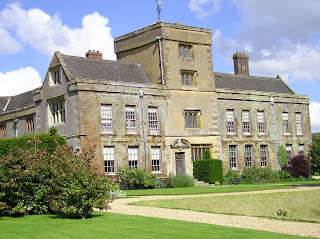
It’s a strange place, but homely, somehow. The gardens are lovely, with a massive tree that has pinecones sitting on top of the flattish branches in groups of twenty or more, and various shrubs that have been trimmed into unusual shapes.
After we’d done the house, gardens and church, we headed back and stopped off in Greens Norton, another pleasant village. We went for a walk, which turned into a bit of a marathon, because we were following a path that led to something called the Pocket Park. One woman we met claimed it was lovely, so we persevered. After what seemed like half an hour of walking, we came across an area that used to be clay pits. It’s now been allowed to go back to nature, and this is the famed Pocket Park. A lake has been formed - it’s not very large, rather more of a oversized pond - and it’s covered in perfectly normal water scum. That’s fine for the wildlife, but not overexciting to look at. However, we were too tired to walk all the way back straight away so we sat and watched some strange little flying creatures that might have been dragonflies, but didn’t really have the look of them. Went into the pub on the way back and had a drink.
Finally we stopped in Towcester, where Celia’s two sisters both used to live and work. It’s an ancient town - I think it’s Roman name was Ludonium - and Watling St (the famous Roman road) goes through the middle of it, and acts as its High St. It’s an all right sort of place, but doesn’t seem to have much charm. We had fish and chips for tea, and a rather soggy Cornish Pasty. The English don’t seem to know how to make their own speciality: fish and chips. (Celia said the people in the shop weren’t English, but Chinese.) The fish was fine, but the chips lacked something - which the English usually disguise, I suspect, with vinegar.

Some things that make England different to NZ

Baths appear to be deeper and narrower. Getting in or out of a bath requires a high stepping manoeuvre; you have to watch you don’t catch your foot on the edge and go for a burton.
I’d forgotten that a lot more people use gas for cooking - and grills above the cooker for making toast.
Op shops are called Charity Shops and they abound. And the stuff in them is very clean, very tidy, always in good condition. We’ve visited nearly every one we’ve seen, I think, and accumulated more books than we can hope to bring back with us.
The Eftpos (debit card) system doesn’t seem to be as well integrated as it is in NZ. There you can go anywhere with your Eftpos card and it will work. You can’t always guarantee it will here. Sainsburý’s supermarket particularly doesn’t like ours.
You can park your car either way on the side of the road. In other words, you don’t have to park facing the same way as the traffic. So cars are parked higgledy-piggledy all along the road.
People don’t have to wear helmets when they’re riding bicycles; but they can’t smoke inside. That law came in on the 1st July, with much hoo-hah, and one MP has already been caught on a train smoking with the cigarette out the window. He tried to claim he was smoking outside.
People still say, I shan’t, as part of their normal conversation.

Saturday, July 07, 2007

Interneting in the Rain

Yesterday we tramped around in drizzling rain trying to find one of the pubs in Northampton that has internet access available via The Cloud. The first place we went to was under new management, and the staff knew nothing about Internet access. One of the blokes at the counter suggested another public house a street away: this turned out to be only BT (British Telecom) wireless access, which wasn’t any good to us. We only discovered this after we’d bought a coffee and tea. (Strong, strong coffees and teas.)
Finally we made our way to Abington St and found two Cloud access places opposite each other. If it hadn’t been raining so hard we could probably have sat out in the street between them (it’s a no vehicular traffic area) and picked up the signal. In the end we chose Lloyds No 1 over the Wedgewood, because the music was too loud at the latter.
Lloyds No 1 is part of a chain of pubs around the country, and provided us not only with great tea and hot chocolate (covered in cream, the latter was) but with inexpensive meals. We got through some business on the Net and some blogging, but no Skyping. However we were back in town this morning because we wanted to look at the Market in Northampton (where some woman was selling very good DVDs, but changing the price to suit the customer!) so we skyped two of the kids and had a conference call with them.